
How to Prepare for an ERTC Audit Step-by-Step: A Complete Guide
Preparing for scrutiny is easier when you know exactly how to prepare for an ERTC audit step by step. This guide explains what auditors expect, how to assemble airtight documentation, and how to present your position confidently. You will leave with a practical checklist, process maps, and tools to reduce risk, speed resolution, and protect cash flow.
Key takeaways:
- Build a document set that mirrors how the IRS examines: eligibility, wages, and calculations.
- Map each requested item to labeled evidence; avoid overproduction and contradictions.
- Recreate the ERTC calculation with transparent workpapers and quarter-level tie-outs.
- Prove eligibility with specific government orders or precise gross receipts tests.
- Segregate PPP wages and other credits to prevent double dipping and penalties.
- Manage communications with one spokesperson, clear timelines, and a submission log.
What Is an ERTC Audit and Why Preparation Matters
The Employee Retention Tax Credit (ERTC) is a refundable payroll tax credit for eligible wages paid during specific 2020–2021 periods. Audits are commonly triggered by amended payroll returns claiming large refunds, inconsistent gross receipts tests, vague suspension claims, or promoter-prepared filings lacking contemporaneous analysis. Some exams start with a mail request; complex cases may involve in-person or virtual reviews.
ERTC audits are conducted primarily by the IRS, typically through Small Business/Self-Employed (SB/SE) examiners. State workforce or revenue agencies may review payroll and wage data separately, but the ERTC determination rests with the IRS. Timelines vary: initial Information Document Requests (IDRs) often require responses within 10–30 days, with extensions possible for reasonable cause and good communication.
Outcomes range from full acceptance to adjustments that reduce or deny credits. Examiners may assert penalties for negligence or substantial understatement, plus interest on disallowed amounts. In cases involving willful misstatements or fabricated documents, referrals can escalate to fraud examination. Thorough preparation significantly reduces these risks and shortens cycle time to resolve issues.
Knowing how to prepare for an ERTC audit step by step helps you control the narrative. You front-load your strongest evidence, address gray areas proactively, and ensure all figures reconcile to filed returns. A complete, consistent package demonstrates credibility and often narrows the audit scope. It also prevents hurried, inconsistent responses that create avoidable exposure.
Common ERTC Errors That Trigger Audits

Build your audit file before the first call. Assemble a consistent, labeled set that supports eligibility, wage qualification, and reconciliation to returns. Use quarter-level folders and a master index.
- Filed Forms 941 and any 941-X for each affected quarter, including all schedules and attachments.
- PPP loan documents: promissory notes, draw dates, forgiveness applications/decisions, and wage allocations.
- Gross receipts by quarter for 2019 through 2021, with methodology notes and accounting method consistency.
- Government orders that caused full or partial suspensions: exact text, issuer, dates, and operational impact.
- Payroll registers, timecards, tips/union details, and employer-paid health plan cost allocations.
- Ownership and aggregation documentation for controlled groups or common control (charts and EIN list).
- Workpapers supporting qualified wages, per-employee caps, health cost allocations, and credit rates.
- Advisor correspondence: eligibility memos, calculations, engagement letters, and revision history.
These records should tie to your general ledger at a detail level. Label with quarter, EIN, and Bates numbers. If you used a third-party service, request native calculation files, not only PDFs. Keep a separate folder for privileged materials to avoid inadvertent disclosure.
Step-by-Step: How to Prepare for an ERTC Audit

Step 1: Identify scope and quarters under review from the audit notice Read the letter line by line. Note quarters, EINs, issues cited, and due dates. List each requested document verbatim in a request log. Confirm whether the examination is correspondence-based or field. If the notice is ambiguous, call the examiner to clarify scope and submission format.
Step 2: Assign an internal point person and engage a qualified tax professional Designate one spokesperson who manages deadlines, submissions, and calls. Engage a CPA or EA with payroll tax audit experience, not just ERTC claims prep. Formalize a power of attorney via Form 2848 so your representative can communicate directly with the IRS, reducing the risk of inconsistent statements.
Step 3: Create a document index and map each requested item to evidence Build a matrix with columns: IDR item, file name, description, quarter/EIN, and Bates range. This prevents missed requests and overproduction. If a document spans multiple requests, note cross-references. Keep nonresponsive materials out. Provide a clean, searchable index with your first submission.
Step 4: Recreate the ERTC calculation with transparent, auditable workpapers Start with raw payroll and benefits data. Show filters for qualified wages, per-employee caps, and employer size rules. Separate 2020 from 2021, reflecting credit rate and cap changes. Summarize by quarter and reconcile to Forms 941/941-X. Lock a “read-only” version and maintain a change log for edits.
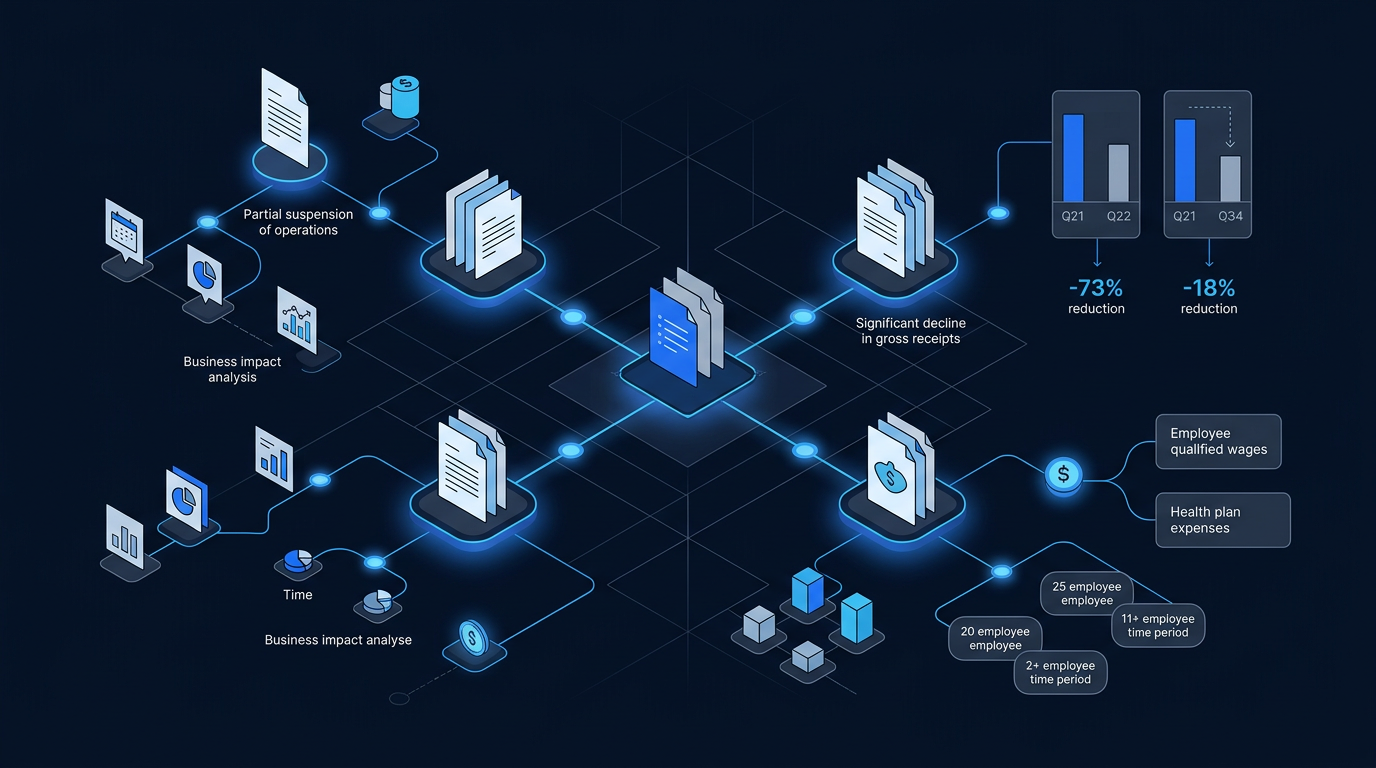
Step 5: Validate eligibility via gross receipts or suspension tests with citations For the gross receipts test, present 2019 baseline and 2020–2021 by quarter, with calculations showing the percentage decline. For suspension, attach relevant government orders and a concise narrative explaining how the order limited commerce, travel, or group meetings, and the impact on your operations.
Step 6: Segregate PPP-funded wages and other credits to prevent overlap Build a clear schedule showing which wages were used for PPP forgiveness and which were reserved for ERTC. Apply the hierarchy that maximizes benefits without double counting. Do the same for WOTC, R&D, and paid leave credits. Flag excluded wages from related individuals and >50% owners, where applicable.
Step 7: Prepare a concise position paper summarizing facts, law, and conclusions Draft a 3–6 page memo covering your business profile, eligibility pathway, wage methodology, and reconciliations. Cite relevant IRS guidance and Notices by number and section. Address foreseeable examiner questions and known gray areas with a reasoned, good-faith interpretation supported by evidence.
Step 8: Quality review: cross-check totals to Forms 941/941-X and GL/payroll Have a second reviewer validate math, tie-outs, and employee-level caps. Confirm healthcare allocations are reasonable and consistently applied. Ensure all narrative statements are provable with documents in the production set. Correct naming inconsistencies before submission.
Step 9: Organize a production package: labeled PDFs, date-stamped, with index Export final PDFs with bookmarks and Bates numbers matching your index. Include a cover letter listing enclosures, your contact sheet, and preferred communication cadence. Submit via the examiner’s secure channel. Retain an identical set internally for reference during calls and meetings.
Proving Eligibility: Gross Receipts and Suspension Tests

Compute quarterly gross receipts declines against 2019 benchmark Prepare a table listing 2019 quarters as the baseline and each 2020–2021 quarter with calculated percent changes. Note the ERTC thresholds for the applicable year. Use the same accounting method used for filed returns. Disclose any restatements and provide adjusted comparisons to preserve consistency.
Document methodology: cash vs accrual consistency and any restatements State your accounting method and confirm it matches return filings. If you changed methods or restated revenue, provide a reconciliation schedule detailing the adjustments. Examiners look for consistency more than perfection; unexplained switches often trigger expanded inquiries.
Compile contemporaneous evidence of supply chain disruptions, capacity limits, or closures Gather emails from suppliers about shortages or delays, shipping notices, production logs showing idle capacity, and internal memos documenting reduced hours or closed departments. Pair these with operational metrics such as throughput, appointment volume, or seating capacity to quantify impact.
Cite specific government orders: issuer, effective dates, and business functions impacted Attach the full text of orders from federal, state, county, or city authorities. Highlight sections that restricted your business function. Provide effective dates and a short matrix mapping affected locations, departments, and timeframes. Avoid relying solely on industry articles or news summaries.
Differentiate nominal vs impact thresholds and supporting metrics Show how restricted operations affected at least a portion of your business. Present revenue share, capacity percentage, or labor-hour metrics. For example, if on-premise services were 35% of 2019 revenue and were suspended, document that proportion and the duration clearly.
Address recovery startup business criteria where applicable If claiming as a recovery startup business, show formation date and gross receipts thresholds as required by law. Provide organizing documents, state registrations, and revenue proof. Keep the claim within the statutory limit for the qualifying quarters and demonstrate no other eligibility path was used simultaneously.

How to Respond to an IRS Audit Letter (CP2000/566 style)
Calculating Qualified Wages Correctly

Define qualified wages by employer size thresholds (2019 FTE counts) Count 2019 full-time employees using the applicable definition. Document methodology and supporting payroll records. For small employers, most wages during eligible periods may qualify. For large employers, only wages paid to employees not providing services may qualify, subject to substantiation.
Include allocable healthcare costs and exclude ineligible payments Identify employer-paid health plan expenses allocable to qualified periods. Use reasonable, consistent allocation methods and tie to carrier invoices or plan reports. Exclude severance, certain leave payments already credited, and amounts paid to disqualified related individuals under ownership rules.
Handle tips, commissions, related individuals, and majority owner rules Include tips subject to FICA; make sure they are documented through payroll. Commissions qualify if properly reported. Exclude wages to majority owners and specified relatives as defined by attribution rules. Maintain clear notes where an employee’s status changes across periods.
Prevent double benefits with PPP, WOTC, R&D credit, and paid leave credits Create a conflict matrix showing each employee’s wages by program. Reserve distinct wage pools to maximize overall benefit without overlap. Document assumptions transparently. Present the PPP forgiveness schedule alongside ERTC allocations so the segregation is obvious at first glance.
Maintain per-employee caps and correct 2020 vs 2021 credit rates Apply the year-specific caps and rates accurately. Lock formulas to prevent accidental over-claims during updates. Provide per-employee summary sheets that show caps applied and totals rolled up to quarter-level credits that reconcile to filed returns.
Create traceable links from GL accounts and payroll to employee-level detail Provide a data lineage view: GL wage accounts to payroll registers to employee lines to ERTC-eligible subsets. Ensure totals tie precisely at each step. Include version history for spreadsheets and a checksum or hash for final files if using a data room, reinforcing integrity.
Organizing and Presenting Your Audit Package

Set up a structured folder system and a master index with Bates numbers Use a root folder per EIN with subfolders by quarter: Eligibility, Payroll, Healthcare, PPP, Calculations, Returns, Correspondence. Bates-stamp all PDFs. The master index lists document title, Bates range, and request mapping. This mirrors how exam teams review evidence.
Use clear file naming conventions tied to the IDR or request list Name files like “IDR_2A_GovOrder_CityX_2020-04-02_Bates001-015.pdf.” Consistency saves examiner time and reduces follow-up queries. Embed quarter and entity identifiers in every file name. Keep native spreadsheets available and provide PDF exports for the official submission.
Prepare executive summary and chronology of key events and orders Open your package with a 1–2 page summary. Include a timeline showing key orders, eligibility triggers, PPP draw and forgiveness dates, and payroll changes. Keep the tone factual. Add a contents page with hyperlinks or bookmarks to expedite navigation during examiner review.
Include calculation workbook with assumptions, inputs, and version control The core workbook should have assumptions on a dedicated tab, input data separately, and formulas documented. Lock cells not intended for change. Include a “Reconciliations” tab showing tie-outs to Forms 941/941-X and to the GL. Save a final version with an immutable timestamp.
Redact PII appropriately while maintaining data integrity Mask Social Security Numbers beyond the last four digits. Remove bank account numbers on checks or statements. Keep employee IDs consistent across files so the examiner can track records without exposing unnecessary personal data. Document the redaction process briefly in your cover letter.
Provide a contact sheet and preferred communication cadence List your spokesperson, backup contact, representative, and their emails and phones. Propose weekly touchpoints and acknowledge response windows. Offer to provide additional items through the same secure channel with incremental index updates for each production.
Managing the Audit: Communications, Deadlines, and Meetings

Calendar all response deadlines and request extensions proactively if needed Input every due date into a shared calendar with reminders at 10, 5, and 2 days. If an item will be late, request an extension before the deadline, citing the reason and a concrete delivery date. Timely, realistic schedules build examiner confidence and can narrow subsequent requests.
Designate a single spokesperson to prevent inconsistent statements All communications flow through one trained person. Others defer to that spokesperson during calls or interviews. Consistency avoids inadvertent contradictions that can expand scope. Prepare talking points and maintain a Q&A document aligned with the position paper.
Respond precisely to Information Document Requests (IDRs)—no overproduction Answer what is asked, not more. Overproduction invites broader lines of inquiry. Each submission should reference the IDR number and sub-items, attach only mapped materials, and include a short cover page listing enclosures. If an item does not exist, say so clearly and explain why.
Prepare for interviews: rehearse facts, roles, and documentation locations Hold a mock session covering eligibility rationale, payroll processes, PPP allocations, and data sources. Participants should know where supporting documents live and who owns which process steps. Provide concise, factual answers and offer to follow up with documents rather than speculating.
Keep a log of submissions, calls, and follow-ups for a complete audit trail Maintain a running log with dates, participants, topics, commitments, and documents produced. Number each production set sequentially. This record helps manage scope, prove timeliness, and prepare for Appeals if needed. Share a cleaned version with your representative.
Maintain a professional, cooperative tone while protecting positions Be responsive and courteous, but do not concede points without review. If you disagree, present your interpretation with citations and evidence. Offer alternative documentation when originals are privileged or contain unrelated sensitive data. Keep communications free of editorial comments.
Common ERTC Audit Issues and How to Avoid Them
Insufficient proof of government orders or reliance on generic industry articles Auditors expect the exact order text and a clear operational nexus. Avoid blog posts or press summaries as proof. Provide the issuing authority’s document, highlight the controlling sections, and explain how they restricted your specific business function.
Inconsistent gross receipts calculations or accounting method switches Switching from accrual to cash to meet thresholds raises red flags. State your method, apply it consistently, and reconcile to filed returns. If restatements occurred, include a schedule with reasons and approvals, so the examiner sees a controlled process.
Double-counting wages with PPP and other credits Create a wage allocation matrix showing how each program was applied. If you used the same wages for PPP forgiveness and ERTC, prepare a corrected schedule. Demonstrate that ERTC uses only excess wages beyond what was needed for PPP forgiveness and other credits.
Misclassification of owners and related individuals as qualified employees Wages paid to majority owners and specified relatives are often disallowed. Prepare a related-party list using ownership and family attribution rules. Exclude disqualified wages early in your calculation and explain your screening method in the workpapers.
Errors from third-party promoters and lack of contemporaneous analysis If a promoter prepared your claim, ask for the underlying eligibility memo, orders, and calculations. Replace generic templates with your actual facts and sources. Examiners discount boilerplate language. Your file should reflect contemporaneous, business-specific reasoning.
Missing aggregation analysis across related entities and states Aggregation rules may combine receipts and employees across controlled groups, altering eligibility and wage limits. Provide an ownership org chart, EIN list, operations, and tests performed. If aggregation applies, show consolidated receipts and unified eligibility assessments.
After the Audit: Outcomes, Appeals, and Record Retention
Understand proposed adjustments, penalty/interest computations, and payment options If the examiner proposes changes, review the explanation and schedules closely. Verify math and tie-outs. Understand any accuracy-related penalties and interest computations. If you agree in part, you may resolve some items and continue to contest others. Discuss payment or refund offsets with your representative.
Evaluate Fast Track Settlement, Appeals, or reconsideration pathways For unresolved issues, consider Fast Track Settlement for mediated resolution or a formal protest to Appeals. Each path has timelines and requirements for position statements and evidence. If new information emerges, ask about reconsideration before elevating, which can save time.
When and how to amend payroll or income tax returns if required If adjustments affect previously filed returns, coordinate corrective 941-X or income tax amendments. Align timing to minimize cascading issues. Document the rationale for changes and reference the audit findings in your internal records. Keep a reconciliation showing old vs new amounts.
Update internal controls to prevent recurrence of issues Implement controls for revenue tracking, government order documentation, and wage allocation matrices. Use checklists for future credits and incentives. Train staff on aggregation rules and related-party screening. Document procedures in a compliance manual with ownership of each step.
Record retention best practices and statute of limitations considerations Retain ERTC-related records at least as long as the statute of limitations for the relevant returns, often three years from filing, potentially longer for amended returns or if substantial omissions are alleged. Keep digital backups in a secure repository with access logs and metadata.
Next steps if you discover errors before or during the audit (voluntary corrections) If you find a mistake, quantify it promptly. Voluntarily provide corrected schedules with an explanation. Good-faith, timely corrections can mitigate penalties. Do not destroy or alter prior submissions; preserve an auditable trail that shows what changed and why.
Practical ERTC Audit Support Tools and Processes
Automation and secure collaboration improve audit readiness and speed. SMBs can save dozens of hours by standardizing data pulls, checklists, and submission packaging. Consider a secure document vault with role-based access and e-sign workflows for representation letters and IDR acknowledgments. Build templates for eligibility narratives and wage allocation matrices.
Set up recurring data exports from payroll and accounting systems. Freeze quarterly snapshots to prevent drift. Use data validation rules in spreadsheets to guard against over-cap errors and PPP overlap. Adopt a version control scheme with timestamps and reviewer initials. A central “assumptions” register reduces confusion when staff change or audits extend.
Sample ERTC Audit Folder Map and Naming
- 00_Cover_and_Index
- 01_Returns_941_941X
- 02_Eligibility
- 2019_GrossReceipts
- 2020_GrossReceipts
- 2021_GrossReceipts
- GovOrders_Federal_State_Local
- 03_Payroll_and_Health
- Payroll_Registers
- HealthPlan_Allocations
- Tips_and_Commissions
- 04_PPP_and_OtherCredits
- 05_Calculations_and_Reconciliations
- 06_Correspondence_and_Memos
- 07_Privileged_NotForProduction
Name files with IDR references, quarter, EIN, and a short descriptor. Maintain a “Produced_Sets” subfolder to store each production as submitted, unchanged.
ERTC Year-by-Year Rules Reference Table
Note: Apply the precise statutory percentages and caps as they appear in controlling guidance. Cite official sources in your position paper and workpapers.
Internal Audit Rehearsal Agenda
- Eligibility method review: gross receipts vs suspension, supporting evidence
- Wage calculation walkthrough: per-employee caps and healthcare allocations
- PPP and other credits segregation: matrix review
- Reconciliations: tie-outs to 941/941-X and GL
- Communications plan: who speaks, what to avoid, escalation rules
- Open risks: what to concede, what to defend, contingencies
Use a stopwatch and keep answers concise. Record the session for internal use to refine talking points.
Data Integrity and Redaction Tips
- Generate PDFs from source systems to preserve metadata where feasible.
- Apply consistent redactions across all instances of PII.
- Validate that redaction layers are not reversible.
- Keep a hash or checksum of each submitted file in your internal log.
- Store original, unredacted files in a restricted-access folder.
Working with Representatives and Advisors
Formalize roles with engagement letters. Clarify who owns the position paper, who signs submissions, and who handles meetings. Require advisors to deliver native calculation models. Establish SLAs for response times, changes, and QA reviews. Agree on a document turnover checklist before each production.
block with trust badges on the provider’s official site — pricing and terms are updated there first.
Choosing an ERTC Specialist CPA vs. Promoter
Conclusion
A successful outcome depends on structure, evidence, and disciplined communication. Assemble a complete, reconciled package, prove eligibility with specific facts, and document wage allocations transparently. Your next step: schedule a readiness review to test your file against a real IDR list, resolve gaps, and align your team before the first IRS call.
FAQ
How does an ERTC audit work step by step?
Step 1: Identify scope and quarters under review from the audit notice Read the letter line by line. Note quarters, EINs, issues cited, and due dates. List each requested document verbatim in a request log. Confirm whether the examination is correspondence-based or field.
Who qualifies for an ERTC audit?
Compute quarterly gross receipts declines against 2019 benchmark Prepare a table listing 2019 quarters as the baseline and each 2020–2021 quarter with calculated percent changes. Note the ERTC thresholds for the applicable year. Use the same accounting method used for filed returns.
What should you know about organizing and presenting your audit package?
Set up a structured folder system and a master index with Bates numbers Use a root folder per EIN with subfolders by quarter: Eligibility, Payroll, Healthcare, PPP, Calculations, Returns, Correspondence. The master index lists document title, Bates range, and request mapping. This mirrors how exam teams review evidence.
What should you know about managing the audit?
Calendar all response deadlines and request extensions proactively if needed Input every due date into a shared calendar with reminders at 10, 5, and 2 days. If an item will be late, request an extension before the deadline, citing the reason and a concrete delivery date.