
Cyber Insurance Requirements Small Businesses 2026 buyer guide
- Confirm the cover limits match your actual exposure.
- Check the excess and any co-insurance clause.
Small businesses buying or renewing coverage need a practical, verifiable cyber insurance requirements checklist for small businesses. Insurers in 2026 tie eligibility and pricing to concrete controls like MFA, EDR, and offline backups. If you can prove them with evidence, you qualify faster and pay less. This guide explains required controls, underwriting questions, documentation, and a 90‑day roadmap.
Key takeaways
- Insurers now “gate” quotes on MFA, EDR/MDR, and immutable, tested backups.
- Evidence matters: screenshots, logs, and policy docs speed approvals and claims.
- Expect deeper questions on vendor risk, segmentation, and continuous monitoring.
- Close gaps like partial MFA or untested backups to avoid exclusions or surcharges.
- A 90‑day plan can meet minimum controls and reduce premiums without trimming coverage.
What Is Cyber Insurance and Why Small Businesses Need It in 2026

Cyber insurance transfers part of the financial risk from attacks or failures tied to your digital operations. By 2026, policies have matured with clearer definitions, pre-breach services, and firmer control requirements. Carriers verify security baselines before binding. As a result, losses from ransomware and business email compromise trend lower for insureds while prepared buyers secure broader terms and lower retentions.
To ground the need for coverage, consider the top SMB threat patterns and operational impacts:
- Ransomware halts revenue, disrupts service delivery, and drives expensive recovery and downtime.
- Business email compromise diverts invoices and payroll, creating cash-flow crises and client disputes.
- Data theft triggers notification, credit monitoring, legal counsel, and potential regulatory scrutiny.
- Supply chain compromises through MSPs and SaaS propagate incidents beyond your perimeter.
- Automated discovery and phishing scale attacker reach faster than manual defenses can respond.
Meanwhile, exposure grows as teams adopt cloud apps, remote tools, and AI workflows without uniform controls. In practice, that means shadow IT, inconsistent identity policies, and fragmented logging. Practical mitigations include consolidating identity providers, enforcing phishing-resistant MFA, and standardizing device baselines. Insurers increasingly condition eligibility on these foundational measures.
On the compliance front, regulatory pressure rises through state privacy laws and sector standards. Additionally, commercial contracts now embed security clauses, incident reporting windows, audit rights, and proof of cyber insurance as prerequisites for vendor onboarding. Payment processors enforce PCI duties, while healthcare, education, and finance expand data stewardship. Even micro-businesses must document controls as routine governance.
Because underwriting hardened, carriers evaluate security maturity via a structured control checklist corroborated by evidence. Typical artifacts include screenshots, policy excerpts, and test logs. The review spans technical and business context, aligning coverage with demonstrated resilience rather than questionnaire responses alone.
Key control areas most underwriters now test and score:
- MFA coverage scope across admin, privileged, email, VPN, and third-party access.
- Endpoint security with EDR or MDR, alerting fidelity, and 24/7 response pathways.
- Backup architecture, including isolation, immutability, and routine restore tests.
- Patch cadence for operating systems, browsers, and critical SaaS applications.
- Email security layers, including DMARC, advanced filtering, and impersonation controls.
- Incident response readiness with roles, playbooks, and external counsel on retainer.
To connect controls to buying outcomes, note how risk posture translates into terms:
Stronger controls unlock clearer wording, fewer exclusions, and better pricing stability over renewals. Conversely, gaps trigger sublimits or conditional binders that require proof of remediation within set timelines. Treat the underwriting checklist like an operational roadmap, not just a form.
comparison box with logos and bullet benefits
See if you qualify: Get 3 cyber insurance quotes in 5 minutes
Core Cyber Insurance Coverages to Understand

First-party coverage addresses costs your business incurs to investigate and recover. Expect incident response coordination, forensic analysis, data restoration, business interruption, and extra expense coverage. Policies increasingly include pre-breach assessments or discounts for approved tools. Verify waiting periods, sublimits, and restoration triggers for cloud versus on-premises assets.
Third-party coverages handle claims from others affected by your incident. Privacy liability applies to personal data exposures and regulatory actions. Network security liability responds to failures that cause outages or spread malware to customers. Media liability covers IP and defamation risks from content. Contractual indemnification can apply when partners seek recovery under security clauses.
Ransomware and cyber extortion coverage funds negotiations, legal guidance, and response costs. Many carriers require you to use approved vendors for negotiation and payment logistics. Sublimits and co-insurance are common. Policies increasingly require proof of backups, MFA, and EDR to honor extortion and data restoration claims. Consider endorsements for data exfiltration and double-extortion scenarios.
Coverage for regulatory fines and penalties depends on jurisdiction and insurability. Some policies limit to defense costs or impose strict sublimits. Clarify treatment for state privacy actions, card brand assessments, and sector regulators. Ensure panel counsel with privacy expertise is included. Confirm whether voluntary notifications and credit monitoring are covered when mandated by contract.
Hardware “bricking” addresses devices rendered unusable by malware or corrupted firmware. Not all policies include it by default. Dependent business interruption covers losses when a critical vendor or cloud provider goes down due to a covered event. Scrutinize named versus unnamed providers, waiting periods, requirements, and service-level dependencies across your stack.

Multifactor authentication (MFA) is non-negotiable. Enforce it for email, VPN, remote access, and all privileged accounts, including cloud admin roles. Where legacy systems lack native MFA, deploy compensating controls like gateways, app proxies, or conditional access. Document coverage maps and exceptions with planned remediation dates to satisfy underwriting scrutiny.
Deploy endpoint detection and response (EDR) or next-gen antivirus across all workstations and servers. Centralized monitoring is expected, with 24/7 response via internal staff or an MDR provider. Show deployment percentages, alert workflows, and containment capabilities. Legacy AV without behavioral detection and isolation functions often fails insurer minimums for 2026 eligibility.
Backups must be regular, offline or logically isolated, and immutable. Implement daily backup for critical systems, with separate credentials and multi-admin approval for deletion. Quarterly restore tests are now a common underwriting proof point. Keep signed test logs, screenshots, and job histories. Replicate backups to a second region or provider to reduce dependent risk.
Email and web security controls reduce BEC and phishing. Enable inbound authentication (SPF, DKIM) and enforcement via DMARC at p=reject. Deploy phishing protection, URL rewriting, and attachment sandboxing. Use outbound DLP for sensitive data. Enforce browser isolation or URL filtering for risky categories. Keep configuration exports and policy screenshots ready as evidence.
Secure remote access with least-privilege VPN or zero-trust network access. Require device posture checks and MFA for every session. Log all connections, including service accounts. Disable split tunneling where unnecessary. Limit admin protocols from the internet. Provide architecture diagrams, sample logs, and policy snippets to show how access pathways are controlled and audited.
Adopt privileged access management (PAM) to govern admin credentials. Remove local admin rights from standard users. Use elevation and vault rotation for shared admin accounts. Record admin sessions for critical systems. Map privileged roles across SaaS, IaaS, and on-prem infrastructure. Keep access reviews and approval workflow artifacts to prove control.
Implement patch and vulnerability management with defined SLAs. Critical patches on internet-facing systems should meet a short window, with risk-based exceptions documented. Automate scanning weekly or continuously. Track metrics and report aging vulnerabilities. Provide sample scans, tickets, and change records as underwriting evidence of consistent hygiene.
Run security awareness training for all staff at least quarterly. Include simulated phishing with escalating sophistication. Track completion rates and repeat-offender coaching. Add role-based modules for finance and IT admins. Maintain training rosters, policy acknowledgments, and campaign analytics. Underwriters reward proven, measurable improvements in click and report rates over time.
Maintain an incident response plan (IRP) and test it annually with tabletop exercises. Name roles, contact trees, law enforcement engagement, and insurer notification procedures. Include pre-approved vendors from your carrier’s panel. Store hard copies and offline contacts. Keep after-action reports showing lessons learned and policy updates following each exercise.
Segment networks to isolate critical systems and third-party connections. Use VLANs, firewall rules, and identity-aware access. Separate admin networks from user subnets. Restrict east-west traffic and apply microsegmentation for crown jewels. For SaaS and IaaS, use separate tenants or subscriptions for prod and dev. Provide topology diagrams and rule examples to underwriters.
Establish 24/7 monitoring and alerting via SIEM or an MDR provider. Define alert thresholds, escalation paths, and on-call rotations. Retain logs for at least 90 days online and longer in cold storage. In cloud apps, enable audit logging and export to the SIEM. Share a runbook snippet and a redacted timeline to demonstrate operational readiness.
Encrypt sensitive data at rest and in transit. Use strong, managed keys with rotation policies. Turn on full-disk encryption for endpoints and server volumes. Enforce TLS for apps and email. For SaaS, confirm provider encryption and your key options. Keep key management procedures, rotation logs, and screenshots of encryption settings for underwriting submission.
Manage vendor risk with tiering and security addenda in contracts. Require attestations or certifications for critical providers. Map data flows and least-privilege access. Collect SOC reports and pen test summaries when available. Track remediation items. Underwriters will ask about your most critical SaaS, cloud, and MSP relationships and how you assess and monitor them.
Publish documented policies: acceptable use, BYOD, retention, and access control. Align policies with your implemented controls. Mandate MFA, password standards, and remote work rules. Define data classification and retention timelines for legal hold. Have employees acknowledge policies annually. Provide signed policy acceptance records during underwriting.

EDR vs. Antivirus: What Insurers Require in 2026
MFA for SMBs: How to Roll Out in 7 Days
icons
- Confirm the cover limits match your actual exposure.
- Check the excess and any co-insurance clause.
Pass insurer control checks: Save 20% on SMB security bundle
Underwriting Questions You Should Be Ready to Answer
Underwriters request a clear view of your tech stack and asset inventory. List endpoints by OS, servers by role, cloud providers, apps, and critical data stores. Include architecture diagrams and crown-jewel maps. Identify single points of failure. A concise, accurate inventory demonstrates control and informs appropriate limits and endorsements.
Expect detailed questions on MFA coverage. Identify all account types: employees, contractors, admins, service accounts, and third-party vendor logins. Break down MFA methods by system: email, VPN, SSO, remote management tools, cloud consoles, and privileged apps. Underwriters probe legacy exceptions and compensating controls. Provide configuration screenshots and an MFA coverage matrix.
Backups draw deep scrutiny. Describe your architecture: frequency, isolation method (air gap, immutability), credential separation, and retention. Provide evidence of quarterly restore tests with documented RTO/RPO for key systems. Show that backups are not domain-joined and cannot be deleted by ransomware operators. Include redacted backup job reports and audit logs.
Patch management questions cover timelines and scanning cadence. Share SLAs for critical, high, and medium vulnerabilities. Show your discovery process for internet-facing assets, including external attack surface scans. Provide monthly remediation metrics, exception approvals, and change tickets. Demonstrate a repeatable loop: scan, prioritize, patch, validate, and report.
Monitoring and response are core to eligibility. Underwriters ask about EDR/MDR coverage, SIEM sources, log retention, and alert workflows. Provide your on-call rotation, escalation paths, and average time to containment. Share a recent redacted incident timeline that proves rigor. Show integrations that automate isolation and ticket creation.
Third-party dependencies and data sharing practices must be transparent. List critical vendors, data types shared, and access methods. Reference security addenda, rights to audit, and notification timeframes. Underwriters may ask for SOC 2 reports or ISO certificates for your top providers. Map compensating controls when vendors lack certifications or strong controls.
Share historical incidents and near misses candidly. Outline root causes, controls added, and lessons learned. Underwriters reward improvement trajectories and governance discipline. Avoid vague statements. Provide a short chronology with corrective actions and evidence—policy updates, new tooling, and training results tied to the event.
Your compliance posture influences underwriting comfort. Clarify scope and status of PCI DSS, HIPAA, SOC 2, or ISO 27001. For privacy laws, describe data subject request workflows, retention policies, and breach notification readiness. Provide recent audit reports or external assessments. Emphasize governance cadence—quarterly reviews and board reporting.
Ransomware Incident Response Playbook (SMB)
How to Document and Prove Control Implementation

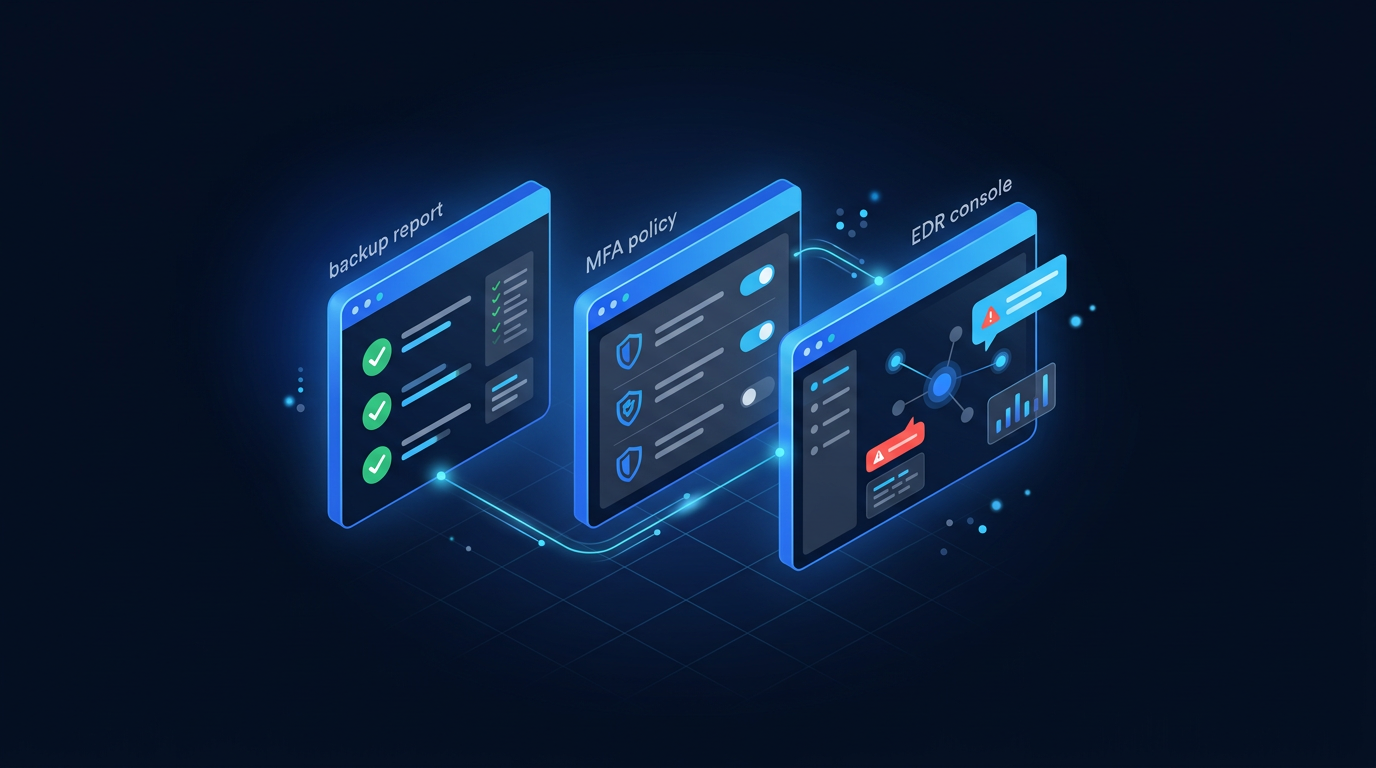
For a rigorous cyber insurance requirements checklist for small businesses, start with evidence that is reproducible and time-bounded. Provide screenshots and configuration exports under change control. For MFA, include admin center settings, conditional access policies, and coverage reports. For EDR, export device coverage, policy status, and recent detections. Redact user data and attach policy PDFs with version history and approval signatures.
To keep evidence usable across renewals and claims, maintain a single repository with an index and dates. Organize by control domain, assign owners, and lock files against edits after submission. Record the tool used, the query or filter applied, and the timestamp for each artifact. These small details prevent disputes about scope, recency, or authenticity and accelerate underwriting review.
- Evidence must be reproducible, time-stamped, and mapped to specific controls.
- A single indexed repository cuts renewal time and claim friction.
- Underwriters favor artifacts that demonstrate enforcement, not intent.
- Redaction, approvals, and version history protect privacy and integrity.
Change management records demonstrate process reliability. Therefore, show ticketing histories for patching, access changes, and configuration updates. Include approvals, testing notes, and rollback plans. Audit trails from identity providers and endpoint managers prove that access and configuration baselines are enforced rather than aspirational. Time-stamped logs bolster claims support.
Because restorability—not backups—wins claims, backup restore test logs are decisive. Keep restore notes, screenshots, checksums, and application validation results. Capture RTO/RPO achieved versus target. Store backup job summaries and immutable retention settings. Underwriters look for separation of duties and deletion protection. Evidence should show quarterly testing across varied systems.
For the human layer, track training completion per user and campaign. Export reports from your awareness platform with pass rates and phishing click/report metrics. Attach targeted coaching results for repeat offenders. Include attestations of policy acknowledgments. Continuous improvement across quarters is persuasive during both underwriting and post-incident claims review.
For third parties, vendor security files should include completed questionnaires, SOC reports, penetration test summaries, and contract clauses covering MFA, encryption, notification windows, and. Map vendor risk tiers and review cadence. Maintain issue logs and remediation tracking. Underwriters value a living VRM program over a one-time due diligence exercise.
To ease audits and renewals, prepare by organizing artifacts to match application sections: Identity, Endpoint, Backup, Email/Web, Network, Monitoring, IR, Training, Vendors, and Policies. Use a labeled folder structure and an evidence register with owners and dates. At renewal or claim time, this reduces friction, shortens response windows, and can protect coverage positions.
Evidence package essentials:
- Control artifacts: MFA, EDR, backups, email security, and network controls
- Governance artifacts: policies with versions, approvals, and attestations
- Operational logs: tickets, change approvals, audit trails, and monitoring alerts
- Human risk data: training metrics and coaching outcomes
- Third-party risk: SOC reports, contract clauses, and remediation tracking
Comparison of evidence strength:
In closing, assemble evidence with repeatability in mind and map each artifact to a control and application question. As a next step, create a dated evidence register and assign owners for quarterly refresh.
Cyber Insurance Application: Documents You Need
What counts as acceptable MFA evidence for underwriters?
Provide admin center exports showing conditional access policies, targeted user and device scopes, enforced methods, and exclusions. Include effective coverage reports and the timestamp. Attach the approved MFA policy PDF with version history and signatures. Redact user identifiers where needed, but keep group names intact so scope can be validated without exposing personal data.
How often should we test backups to satisfy insurers?
Test quarterly across varied systems and data classes, not just one server. Document the restore with steps, screenshots, checksums, and application validation. Capture the achieved RTO/RPO against targets and note any tuning performed. Store immutable job summaries and access logs to demonstrate separation of duties and deletion protection.
What change management artifacts reduce claim disputes?
Produce ticket histories that link requests to approvals, testing evidence, and rollback plans. Add before/after configuration diffs and the implementation timestamp. Include audit trails from identity and endpoint platforms that enforce baselines. This chain of custody shows that controls were active at the time of loss and narrows arguments about negligence.
How should vendor risk evidence be organized?
Segment by risk tier and service type. For each vendor, keep the latest SOC report, questionnaire, pen test summary, and contract extracts covering MFA, encryption, notification windows, and. Track issues and remediation dates. Note review cadence and ownership. This shows continuous oversight rather than a one-off onboarding check.
What makes training evidence persuasive to underwriters?
Show trend lines per quarter: completion rates, phishing click and report metrics, and targeted coaching outcomes. Attach policy acknowledgment attestations and any disciplinary or reinforcement actions. Break out high-risk roles for clarity. Demonstrated improvement over time indicates real behavior change, which correlates with lower incident frequency and impact.
Common Gaps That Lead to Denials, Exclusions, or Higher Premiums
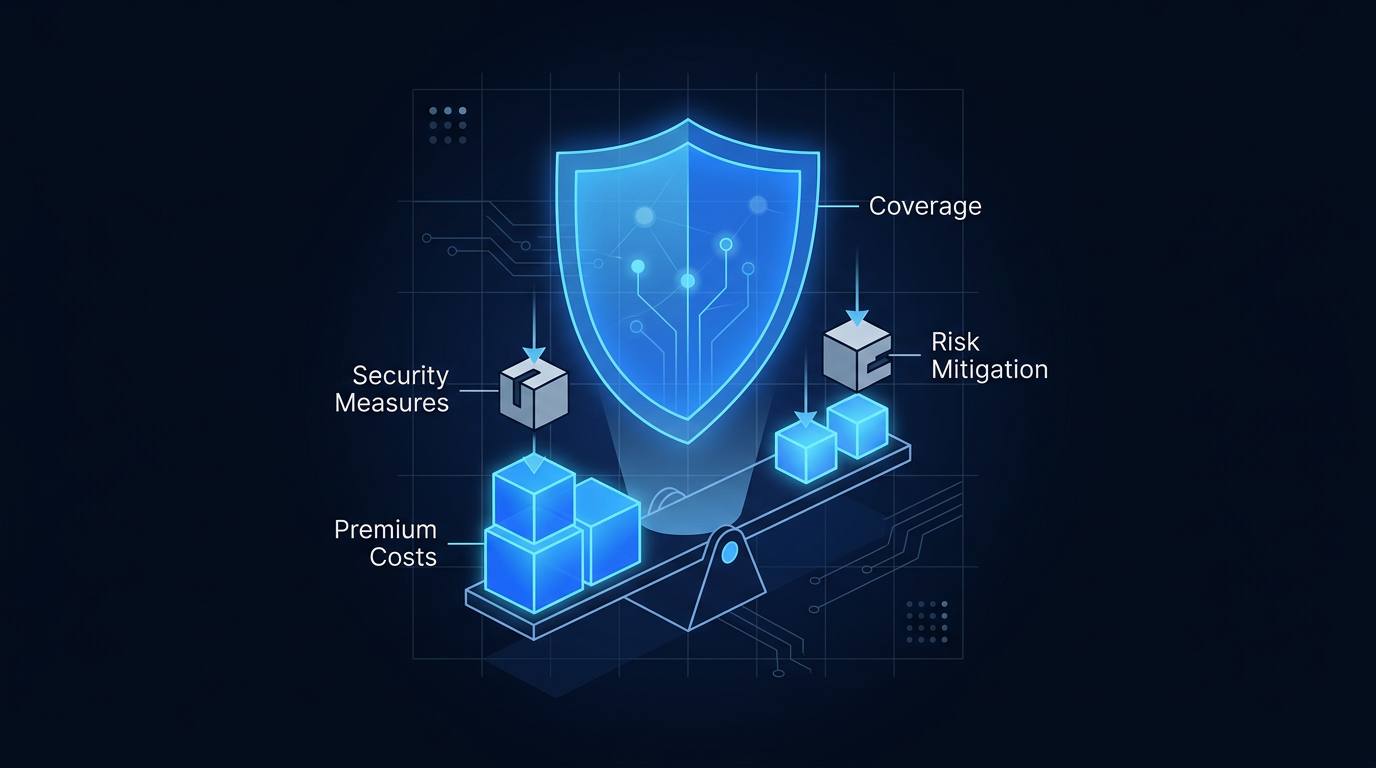
Partial MFA coverage is a frequent failure. Admin accounts may be protected, but service accounts, legacy apps, and contractor logins slip through. Remote desktop services and MSP tools without enforced MFA are red flags. Create an MFA exception register with deadlines and compensating controls. Insurers increasingly decline or surcharge for these gaps.
Unmonitored EDR provides little underwriting comfort. If the console shows devices offline, outdated agents, or disabled protections, you risk surcharges. Traditional AV without behavior-based detection and isolation will not meet 2026 minimums. Establish deployment SLAs, enforce tamper protection, and integrate EDR alerts with ticketing and on-call rotations.
Backups tied to the domain or accessible with single-factor credentials are high-risk. If you cannot produce recent, successful restore test evidence, expect exclusions for ransomware data loss or coinsurance. Implement immutable storage, MFA for backup admin, and workload-level encryption. Show segregation of duties between backup operators and domain admins.
Default configurations on email and cloud platforms undermine risk controls. DMARC set to none, global admin overuse, and permissive OAuth scopes allow attackers to persist. Baseline systems with hardening guides. Use least-privilege roles and conditional access. Export configuration baselines and periodic drift reports as durable evidence of discipline.
Shadow IT and unmanaged devices expand your attack surface. Unknown SaaS connections, personal endpoints without EDR, and unsanctioned file sharing invite compromise. Deploy discovery tools and device compliance checks. Enforce SSO-only access to corporate apps. Document remediation steps and exceptions. Show governance via quarterly shadow IT reviews.
Inconsistent patching across servers, endpoints, and network gear creates exploit windows. Underwriters look for uniformity, not just Windows patching. Include firmware and hypervisors. Present consolidated reports that cover endpoint managers, vulnerability scanners, and network devices. Track and close high-severity findings within your SLA windows.
Unclear incident response roles and no 24/7 escalation path delay containment. Define on-call schedules, alternate contacts, and insurer notification steps. Store hard copies of contact trees. Test after-hours paging during tabletop exercises. Carriers expect evidence of capability, not just business-hours coverage, for ransomware scenarios.
Selecting the Right Limits, Endorsements, and Retentions

- Build quantified loss scenarios to defend your limit selection to finance and underwriters.
- Align business interruption coverage with real dependencies, waiting periods, and vendor SLAs.
- Add endorsements for social engineering and funds transfer fraud with auditable verification steps.
- Pre-select carrier-approved breach response vendors and rehearse handoffs in exercises.
- Set retentions at a level matched to cash flow, typical incident size, and control maturity.
To estimate loss scenarios and size limits in a structured way, start by quantifying the primary threat vectors that drive severity. The cyber insurance requirements checklist for small businesses should include ransomware with downtime, business email compromise, and data exfiltration. Translate operational impacts into cost line items to avoid undervaluing contingent expenses during recovery.
For ransomware modeling, build out downtime, overtime, forensics, restoration, and potential data exfiltration costs. For business email compromise, include funds transfer exposure, legal review, and customer remediation. Add regulatory defense and notification volumes where personal data appears. Create low, medium, and high event bands to justify limits to finance stakeholders using consistent, documented assumptions.
To choose business interruption and dependent BI limits aligned to your operating model, map revenue-critical processes to their upstream providers. If your revenue depends on a small number of cloud services or a key MSP, dependent BI should reflect realistic outage durations. Check waiting periods and proof requirements, then compare them to actual recovery times observed in your continuity tests.
As practical BI calibration buyer guide
- Confirm the cover limits match your actual exposure.
- Check the excess and any co-insurance clause.
- Inventory top five external dependencies and their RTOs and RPOs.
- Compare vendor SLAs to incident histories and your own failover performance.
- Validate waiting periods against mean time to restore in past disruptions.
- Document sublimits, exclusions, and evidence thresholds required at claim time.
Add social engineering and funds transfer fraud endorsements where appropriate, but verify operational fit. Confirm coverage triggers and verification steps, such as callback procedures for wire changes, dual approvals, and validation. Ensure finance teams are trained and that procedures are documented and consistently followed. Underwriters favor insureds who can demonstrate layered prevention and verification controls.
Ensure your breach response panel is fit for your size and sector by curating carrier-approved vendors that match your data footprint and jurisdictional reach. Select forensics, legal, PR, and notification vendors approved by your carrier. Confirm pre-breach services like incident response planning, training, and vulnerability assessments. Pre-negotiate rates where possible to reduce friction during a high-tempo event.
As an operational readiness step, keep vendor contacts in your incident response plan and test notification handoffs during tabletop exercises. Validate 24/7 availability, conflict checks, and evidence preservation workflows. Capture findings in after-action reports and update playbooks, so procurement, legal, and IT can execute without delay during an actual claim.
Balance retentions against cash flow and risk appetite by modeling the costs you are likely to self-fund each year. Higher retentions can reduce premiums if your controls are strong and you can absorb small incidents. Model typical loss components—IR retainers, point containment, and short outages—and set retention just below that threshold for predictable budgeting.
Revisit these decisions annually as maturity improves and reserves grow, ensuring alignment with changes in your control environment and vendor landscape. Track claim frequency, near-miss metrics, and control performance to recalibrate. Where feasible, use premium credits tied to improved controls to fund higher limits while maintaining retentions at a sustainable level.
Conclusion: Document your assumptions, vendor dependencies, and control evidence in one underwriting pack. Next step: assemble a cross-functional review with finance, IT, and legal to validate scenarios, endorsements, and retentions before binding.
Cost Factors and How to Reduce Premiums Without Cutting Coverage
Pricing reflects control maturity and eligibility tiers. Carriers apply credits for comprehensive MFA, EDR with MDR, immutable backups, and 24/7 monitoring. They penalize incomplete coverage, inconsistent patching, and weak email security. Quantify your control coverage percentages and present clean evidence packages to access preferred tiers and competitive quotes.
Some carriers bundle MDR, phishing training, or IR retainers at negotiated rates. Adopting insurer-approved tools can unlock discounts and speed claims. Compare total cost of ownership versus standalone vendors. Ensure integrations with your stack and exit options are clear. Capture bundle credits in your quote comparisons to show net premium impact.
Complete security assessments offered by carriers to earn credits. Pre-breach scanning, attack surface management, and tabletop exercises often translate into measurable savings. Use findings to drive remediation with clear timelines. Present metrics at renewal to demonstrate continuous improvement and governance discipline across quarters.
Training results can influence underwriting. Show declining phishing click rates and faster report times. Tie results to reduced BEC exposure and stronger verification steps. For finance and HR, run specialized modules. Provide quarterly dashboards and remedial training outcomes. Underwriters favor programs with measurable outcomes over checkbox completions.
Demonstrate continuous improvement with governance cadence. Hold quarterly security reviews, track metrics, and assign accountable owners. Show closed-loop remediation and policy updates. Maintain a roadmap with milestones and budget alignment. Present this governance evidence in your application. It helps justify better pricing without sacrificing coverage breadth.
Implementation Roadmap: 90-Day Plan to Meet 2026 Insurer Requirements
Start with fundamentals in Days 1–30 to anchor your cyber insurance requirements checklist for small businesses. Build or refresh a complete asset inventory, including cloud tenants and shadow IT. Enforce MFA on email, VPN, remote tools, and all privileged accounts. Harden backups to be isolated and immutable, then schedule and document a restore test. Enable DMARC with a path to reject, deploy phishing protection, and block high-risk URLs.
To convert action into proof during this first month, capture initial evidence artifacts for underwriting. Record dated screenshots of MFA policies, backup immutability settings, and email security controls. Save restore test logs and phishing filter policies. Maintain an index so each artifact maps to a specific control. This early documentation prevents gaps later and speeds quoting.
Days 31–60 expand detection and governance with measurable coverage. Deploy EDR to 100% of endpoints and servers, or contract MDR for 24/7 response if internal staffing is limited. Establish patching SLAs by severity and implement weekly vulnerability scanning with clear remediation owners. Draft your incident response plan, add carrier panel contacts, and run a tabletop exercise.
For continuity with the first month, produce unambiguous evidence as you scale. Export EDR coverage reports showing device counts, policy versions, and tamper protection. Capture patch compliance dashboards and ticket closures tied to SLAs. Store the IRP approval record, tabletop notes, and updated contact trees. These artifacts demonstrate operational readiness rather than intent.
Days 61–90 complete segmentation and access hardening to reduce blast radius. Implement PAM for admins, remove local admin rights, and enforce elevation. Segment critical systems and third-party connections with documented rules and exceptions. Review top vendors, add security addenda, and finalize acceptable use, BYOD, retention, and access control policies.
To close the quarter with insurer-ready proof, assemble a comprehensive underwriting evidence package. Include an index linking each control to screenshots, configs, logs, reports, and signed policies. Note effective dates, control owners, and review cadences. This organized bundle reduces follow-up questions, accelerates binding, and positions you for preferred pricing tiers.
Convert the densest work items into an actionable list you can track weekly:
- Asset inventory completed across on-prem, SaaS, and endpoints.
- MFA enforced for email, VPN, remote tools, and all privileged accounts.
- Backups isolated, immutable, and restore test executed with logs saved.
- DMARC moved from monitor to reject; phishing protections tuned and deployed.
- EDR deployed to 100% of assets; MDR contracted or 24/7 process defined.
- Patch SLAs established; weekly scans running with remediation workflows.
- IRP drafted, approved, and tabletop conducted; contact lists verified.
- PAM live, local admin removed, and JIT elevation operational.
- Network and vendor segmentation rules documented and tested.
- Policies finalized and signed: acceptable use, BYOD, retention, access control.
Track metrics across the 90 days to quantify progress and avoid surprises. Measure MFA coverage by account type, EDR deployment percentage, patch SLA adherence, phishing simulation results, and backup restore RTO/RPO. Score incident response readiness using tabletop findings. Maintain a centralized evidence folder with dated screenshots, logs, reports, and signed policies.
As a final coordination step, assign owners and due dates for each metric. Review weekly and escalate blockers within 24 hours. This cadence keeps initiatives synchronized and produces a time-stamped trail of compliance. The result is a verifiable posture that accelerates quoting and can improve pricing tiers, sublimits, and deductibles.
- Lock fundamentals in 30 days; prove them with dated artifacts.
- Achieve 100% EDR coverage and enforce patch SLAs by Day 60.
- Finish PAM, segmentation, and vendor hardening by Day 90.
- Maintain an indexed evidence pack to speed underwriting and renewals.
+ PDF gate on the provider’s official site — pricing and terms are updated there first.
2026 insurer requirements buyer guide
Everything we verify before recommending 2026 insurer requirements, condensed into a short practical resource you can work through in about ten minutes.
- Confirm 2026 insurer requirements matches your actual situation and budget.
- Write down the criteria that matter most before you compare prices.
- Check the total cost over twelve months, not the headline figure.
- Read the cancellation and refund conditions before you commit.
Open the guide on the provider’s official site — pricing and terms are updated there first.
Prefer it by email?
Add your address and we send it straight to your inbox, along with the updates we publish on this topic.
One email at a time and you can unsubscribe with a single click. Some links earn us a commission, and that never changes what we recommend.
Conclusion
Insurers in 2026 underwrite on proof, not promises. Meet the baseline—MFA, EDR/MDR, immutable backups—and document everything. Close common gaps, choose limits by modeled loss, and show continuous improvement. Next step: assemble your evidence pack this week and submit it with your quote request to secure better terms and faster binding.
What is typically non-negotiable for cyber insurance eligibility in 2026?
Insurers commonly require MFA for email, VPN, remote access, and all privileged accounts; EDR with centralized monitoring; and offline or immutable backups with quarterly restore tests. They also expect basic email security (SPF, DKIM, DMARC), patch SLAs, and an incident response plan. Without these, quotes are delayed or declined, or priced with surcharges.
How much cyber insurance should a small business buy?
Model likely loss scenarios. Combine downtime, forensics, restoration, notification, legal, and potential third-party claims. Include dependent outages for key cloud vendors. Many SMBs align limits to several weeks of gross margin plus response costs. Calibrate business interruption sublimits and waiting periods to realistic RTO/RPO for critical systems and vendors.
Do insurers cover regulatory fines and penalties?
Coverage varies by jurisdiction and policy language. Many policies cover defense costs and some regulatory penalties where insurable by law, often with sublimits. Review definitions, exclusions, and panel counsel expertise. Clarify treatment for privacy actions, payment card assessments, and contract-driven notifications. Expect documentation requirements during claims.
How do I prove controls during underwriting?
Provide screenshots of MFA and conditional access, EDR coverage and policies, backup immutability settings, and restore test logs. Include patching tickets, vulnerability scan reports, email security configs, IRP approvals, training completion data, and vendor security addenda. Organize artifacts in a dated index by control area to streamline review and renewals.
What common gaps increase premiums or trigger exclusions?
Partial MFA, unmonitored or outdated EDR, backups connected to the domain or untested, default email/cloud configs, unmanaged devices, inconsistent patching, and unclear 24/7 escalation. Underwriters flag these as predictors of severe loss. Remediate quickly and present evidence of completion to avoid surcharges and secure broader, cleaner coverage terms.
Can bundling security tools with the policy reduce costs?
Yes. Many carriers offer credits for using approved MDR, phishing training, or backup solutions, and include pre-breach services. Compare bundled pricing against standalone vendors and verify integrations. Keep exit terms in mind. Present bundle adoption and resulting metrics to underwriters to qualify for preferred pricing tiers without sacrificing coverage scope.