
Overview: Best WMS Software for 3PL Warehouses with Multi-Client Support The best wms software for 3pl warehouses with multi client support must separate client data, automate billing, and keep SLAs visible to every shift. Multi-client means your WMS lets you run dozens of brands under one roof without leakage, manual spreadsheets, or blended inventory errors. This guide explains what matters, how to evaluate vendors, and which platforms excel for 3PL complexity and growth.

Warehouse slotting strategies Key takeaways
- Pick true multi-tenant WMS with client-level data isolation, roles, and branded portals.
- Automate 3PL billing by capturing every storage day, touch, and VAS event at the task level.
- Favor vendors with prebuilt EDI and ecommerce connectors to cut integration timelines.
- Validate onboarding flows: rapid client setup, data templates, and SLA configuration.
- Model total cost of ownership across clients, locations, and peak season volumes.
What “multi-client” really means in a 3PL WMS
Multi-client implies tenant isolation, not just labels. Each client’s orders, inventory, and documents must stay partitioned by design. Ownership follows the item, lot, and license plate to block cross-allocation. Client hierarchies support brand families. Role scopes prevent data leaks. Audit logs track every change with timestamps and user IDs.
Key Features 3PLs Need in a Multi-Client WMS
True multi-tenant architecture with client-level data segregation A 3PL-ready WMS must provide tenant isolation so each client’s orders, inventory, and documents are partitioned. Look for client hierarchies, flexible permissions, and data residency options. Prevent cross-client pick errors with ownership tags at the item, lot, and license-plate level. Ensure audit logs show which user touched which client’s data and when.
Flexible billing and rating for value-added services (VAS) Your margins depend on accurate, automated charge capture. The WMS should rate storage by cubic or pallet positions, count touches for pick/pack, and apply kitting, relabeling, or quality-hold fees. Seek rules-based billing with effective dates, minimums, and tiered rates. Native invoice generation and ERP sync eliminate reconciliation gaps and aged receivables.
Advanced inbound/outbound workflows: ASN, cross-docking, wave/batch picking Support ASNs to accelerate receiving and reduce discrepancies. Cross-docking minimizes putaway for fast movers. Wave and batch picking increase throughput for multi-client, multi-channel demand. The system should offer picking methods like zone, cluster, and, and handle replenishment triggers to stabilize downstream packing stations.
Inventory visibility by client, lot/serial, configurable ownership rules 3PLs need traceability for recalls and brand compliance. Choose WMS with granular lot/serial tracking, expiration, and FEFO/FEFO rules per client. Ownership rules should define consigned versus owned stock and dictate billing implications. Cycle counting by client and location helps maintain accuracy without disrupting SLA commitments.
SLA tracking, custom KPIs, and client-specific SOPs Client-specific SLAs require cut-offs, order class rules, and carrier service mappings. Dashboards should surface on-time ship,, and accuracy by client. Attach SOPs at process steps to enforce brand requirements like packaging, inserts, or QC signoffs. Alerting by exception keeps supervisors ahead of misses.
Portal access and branded reporting for each client Offer client portals for order uploads, inventory views, ASN creation, and ticketing. White-label branding builds trust. Provide scheduled reports for inventory aging, order status, and billing detail. Self-service reduces email churn and improves perceived responsiveness during peak weeks.
Strong integrations: EDI, marketplaces, shopping carts, ERPs, carriers Look for broad EDI coverage for retail compliance and turn-key ecommerce connectors to Shopify and Amazon. Prebuilt ERP links simplify billing and reconciliation. Carrier integrations must support label generation, rate shopping, and manifesting. Avoid custom scripts if standard connectors cover 80% of needs.
Automation and robotics support (AMRs, conveyors,, voice) 3PLs scale with automation. Confirm the WMS supports AMR-directed picking, conveyor zone hand-offs, and cues. Voice picking reduces training time for seasonal staff. Device independence matters: run on Android scanners and tablets, and integrate stations for consistent labeling.
Scalability for multi-site operations and seasonal peaks Multi-facility support should replicate client setups across sites quickly. Capacity planning, labor standards, and slotting insights help absorb Q4 peaks. Cloud elasticity reduces performance bottlenecks. Ensure license models do not penalize temporary labor spikes or short-term overflow buildings.
Robust security, role-based access, and audit trails Enforce least-privilege access by role and client. SSO and MFA reduce credential risk for temporary workers. Audit trails must capture every inventory movement, allocation, and override. Compliance needs vary by client; exportable logs and data retention policies protect your brand and theirs.
3PL onboarding SOPs
Key Features 3PLs Need — Summary Table
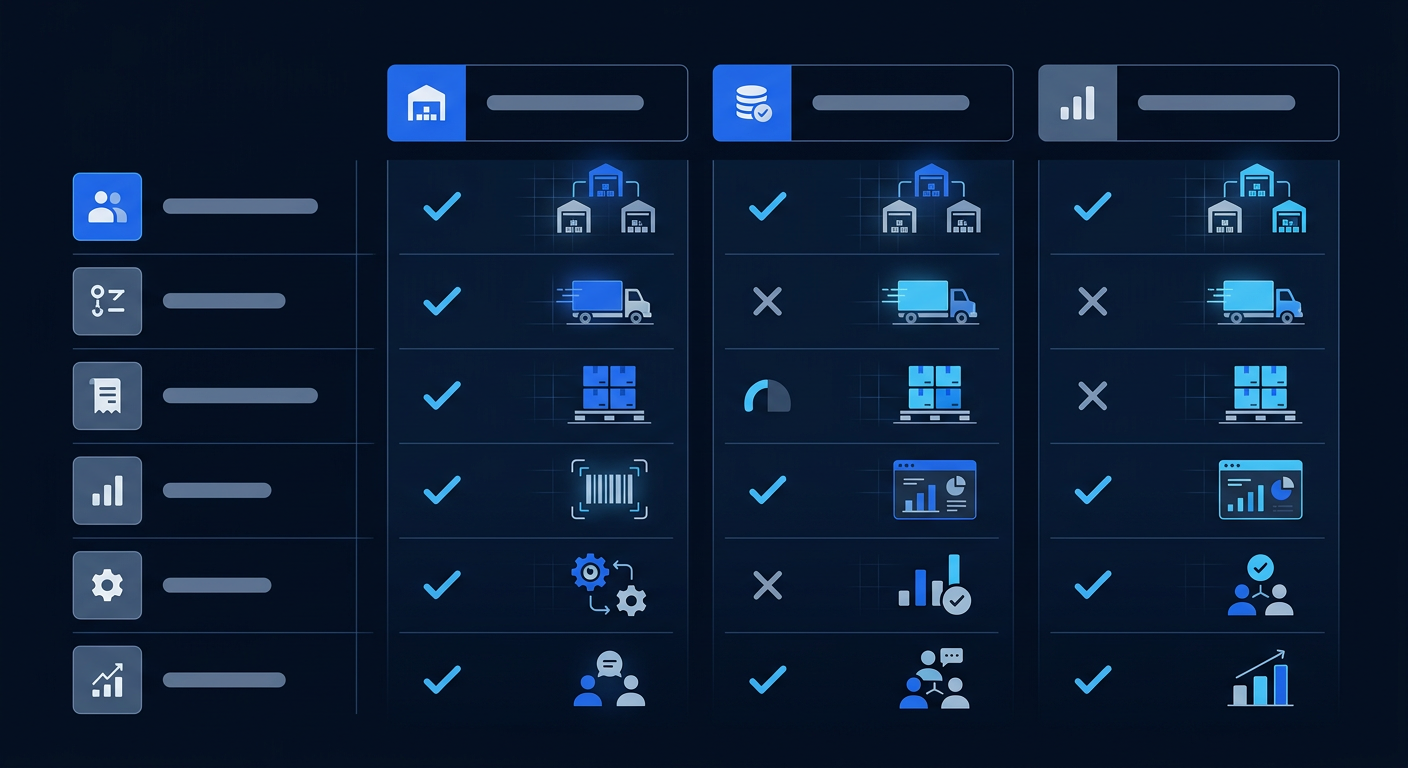
WMS vs ERP for 3PLs
How to Evaluate the Best WMS for 3PL Multi-Client Operations
Map current and future 3PL service offerings (B2B, B2C, omnichannel) Document services by channel and vertical: retail replenishment, marketplace fulfillment, and value-added kitting. Inventory profiles vary by brand, so note dimensions, lot/serial needs, and hazardous flags. Capture future offerings like returns refurbishment or subscription box kitting. A clear roadmap filters vendors that lack those capabilities.
Prioritize configurability vs. customization and Configurability beats custom code for upgrades and rollout speed. Ask vendors to demonstrate client-level rules, fields, and SOPs without engineering tickets. Time-to-value hinges on templates, wizards, and sandbox environments. Excess customization raises support costs and slows new-client onboarding during peak acquisition.
Assess integration ecosystems and prebuilt connectors Prebuilt EDI and ecommerce connectors reduce timelines from months to weeks. Review coverage for 940/945 and 943/944 flows, retail ASNs, and carrier labels. Confirm support for iPaaS platforms to accelerate mapping. A robust marketplace of connectors means lower maintenance costs and faster client cutovers.
Consider pricing models: per-user, per-order, per-location, or hybrid Match pricing to your volume mix. High-touch B2B may favor user-based pricing, while DTC peaks push per-order fees. Hybrid models can align incentives across seasons. Scrutinize add-on fees for EDI maps, labels, extra sandboxes, and data storage. Model scenarios for new clients, SKUs, and additional buildings.
Validate vendor 3PL references and implementation methodology Direct references from similar 3PLs matter. Ask about client onboarding duration, data cleanup, and peak stability. Review vendor methodology, including discovery workshops, integration playbooks, and hypercare. Confirm how they manage change control and knowledge transfer to your superusers.
Test client onboarding workflows, data segregation, and reporting Run a scripted with two distinct clients. Import items, locations, and ASNs, then process B2C and B2B orders simultaneously. Validate that users cannot cross-allocate inventory. Check branded reports and portal views. Measure how long it takes to configure SLAs, SOPs, and billing rules.
Quantify ROI: labor productivity, accuracy, charge capture, SLA compliance Build an ROI model across labor minutes saved, picking accuracy, and charge recovery. Include avoided chargebacks due to EDI compliance and on-time ship. Consider customer lifetime value of retained clients. Tie KPIs to contractual bonuses or penalties. Use baseline and metrics for continuous improvement.
Top WMS Platforms for 3PL Warehouses with Multi-Client Support
Brief introductions to leading 3PL-ready WMS vendors
- Extensiv (formerly 3PL Central): Cloud WMS built for 3PLs, strong client portals, and billing features for storage and VAS.
- Manhattan SCALE/WMS: Enterprise-grade with labor, slotting, and automation depth for complex, multi-site 3PLs.
- Körber (HighJump): Flexible workflows, strong integrations, and adaptability across B2B and DTC.
- Softeon WMS: Robust 3PL billing, flexible rule engine, and extensive EDI support.
- Oracle NetSuite WMS: Native to NetSuite ERP; suitable for 3PLs aligning finance and ops in one stack.
- Cin7 Core (DEAR) + SkuVault (Linnworks): SMB-friendly for lighter 3PL use cases and omnichannel brands.
- Fishbowl with add-ons: Inventory-centric for smaller 3PL operations or hybrid in-house/3PL models.
- ShipBob WMS: Operationally proven for DTC workflows, available to larger in-house or 3PL operations.
Strengths and ideal fit scenarios by warehouse size and complexity
- Small to mid-size 3PLs with fast DTC growth: Extensiv, Cin7 Core + SkuVault, ShipBob WMS.
- Mid-market with mixed B2B/B2C and moderate automation: Körber, Softeon, Extensiv.
- Enterprise 3PLs needing labor management, slotting, and automation orchestration: Manhattan, Körber.
- Finance-led stack or 3PLs expanding into accounting consolidation: NetSuite with WMS module.
Notes on deployment options (cloud, on-prem, hybrid) and global support Cloud-first WMS shortens deployment and scales for peak. On-prem remains for strict compliance or deep automation controls. Hybrid options appear in large networks. Global support matters for multilingual portals, time zones, and data residency. Confirm vendor SLA targets, support, and partner ecosystems across regions.
In-Depth Comparisons: Best WMS Software for 3PL Warehouses with Multi Client Support
Multi-client architecture: tenant isolation, client hierarchies, permissions Manhattan and Körber support complex client hierarchies and per-client wave rules. Extensiv emphasizes strict segregation with easy client setup and portals. NetSuite WMS inherits subsidiary structures but requires design discipline for isolation. Softeon provides granular role permissions and strong audit trails fit for regulated clients.
Billing and contract management: automated charge capture and invoicing Extensiv and Softeon stand out in native 3PL billing, capturing storage, accessorials, and task-based fees without external scripts. Manhattan and Körber often integrate billing via ERP or add-ons, enabling complex rating but with more project work. SMB stacks like Cin7 Core and SkuVault handle light billing but may need external invoicing.
Fulfillment performance: wave strategies, slotting, labor management Manhattan leads in labor standards, engineered time, and slotting optimization. Körber offers robust wave options for B2B and DTC mixes. Extensiv provides wave and batch picking oriented to 3PL workflows. ShipBob WMS is optimized for DTC batch clustering and pack station throughput. NetSuite WMS supports essentials but may require partners for advanced slotting.
Returns, VAS, and kitting for omnichannel 3PLs Softeon and Körber provide flexible returns flows, including disposition rules and refurbishment. Extensiv supports returns and common VAS like kitting, relabeling, and bundling. Manhattan’s configurability covers complex VAS but needs careful design. SMB tools like Cin7 Core + SkuVault fit simpler assemblies and light rework.
Analytics and client dashboards: customizable metrics and alerts Extensiv’s portals expose client-level inventory and order status. Manhattan and Körber deliver deep operational analytics, often paired with embedded BI or external data lakes. Softeon’s dashboarding and exception queues suit 3PL supervisors. NetSuite’s saved searches and analytics work well when finance and ops data live together.
Implementation speed, training, and change management support Cloud-first, template-driven vendors like Extensiv tend to implement faster for standard 3PL workflows. Enterprise suites require more design, testing, and automation tuning. Training must cover supervisors, pickers, client services, and billing admins. Prioritize vendors with role-based training paths and hands-on labs for seasonal labor ramp-up.
Integration and Connectivity Considerations for 3PL WMS
EDI document coverage (940/945/943/944/856/810) and AS2/SFTP Retail and wholesale demand EDI breadth. Ensure native coverage for 940/945 (ship orders/confirmations), 943/944 (warehouse stock transfers), 856 (ASNs), and 810 (invoices). Secure transport via AS2 and SFTP is standard. Pre-certified maps shorten compliance and reduce chargebacks from advanced ship notice mismatches.
Ecommerce connectors: Shopify, Amazon, Walmart, eBay, WooCommerce Turn-key connectors collapse onboarding timelines for DTC brands. Confirm support for order import rules, partial shipments, and cancellation sync. For marketplaces, validate FBA/FBM logic, Amazon Buy Shipping labels, and Walmart seller requirements. WooCommerce and eBay plugins should handle variant SKUs and mapping.
Carrier management and rate shopping: UPS, FedEx, USPS, DHL, 3PLs Rate shopping saves per-shipment costs at scale. Your WMS should integrate with carrier APIs and multi-carrier platforms. Support paperless trade and customs data for international orders. Manifests, closeouts, and pickup scheduling must be automated. Validate label reprints and multi-carton shipments.
ERP and accounting integrations for billing and reconciliation Sync invoices, GL accounts, and client charge codes to your ERP. NetSuite, QuickBooks Online, and Microsoft Dynamics are common endpoints. Use standard items for accessorials and storage. Automate dunning workflows. Reconcile inventory value by client for consigned versus owned stock, and maintain audit-ready records.
API-first design, webhooks, and iPaaS compatibility Modern APIs and webhooks allow event-driven updates for orders, inventory, and shipments. Check rate limits and pagination. iPaaS tools like Celigo or Boomi speed mapping and monitoring. Event payloads should contain client identifiers, license plates, and lot/serial attributes to preserve multi-client integrity.
Data quality, master data management, and client onboarding templates Provide item and location templates with validation rules. Enforce units of measure, barcodes, and dimensions at intake. Use sandbox test cycles to catch ASN and label errors before go-live. Data governance policies prevent duplicate SKUs across clients and maintain clear ownership and billing implications.
Pricing, Licensing, and Total Cost of Ownership for 3PL WMS
Common pricing structures for 3PL-focused WMS Expect per-user, per-order, per-location, or hybrid pricing. Some vendors offer tiers with included connectors or EDI credits. Choose a model that tracks to your revenue drivers and seasonal behavior. Clarify how additional client portals, reports, or sandboxes are priced as you scale.
Hidden costs: integrations, EDI maps, labeling, support tiers Budget for EDI map setup, label formats, custom reports, and premium support SLAs. Training and certification may be extra. Some vendors bill for historical data storage or added environments. Clarify fees for carrier certifications or additional marketplace connectors before finalizing contracts.
Hardware and automation investments and their payback Factor in scanners, printers, packing benches, and potential AMRs or conveyors. Payback comes from labor savings, accuracy gains, and higher throughput. Because automation choices affect WMS design, involve vendors early to validate interfaces, signals, and exception handling that sustain SLA performance.
Contract terms, SLAs, uptime, and support response levels Demand clear uptime commitments and response targets by severity. Review maintenance windows, data backup policies, and RTO/RPO metrics. Ensure named support contacts during peak. Exit clauses should preserve your data access and export format. Multi-year discounts should not lock you into outdated modules.
Scaling costs with new clients, SKUs, and locations Run scenarios adding clients, doubling SKUs, and opening an overflow site. Confirm whether pricing scales linearly or steps up by tier. Understand data caps and performance guarantees. An elastic cloud model helps absorb short-term volume surges without permanent license inflation.
Implementation Roadmap for 3PLs Adopting a New WMS
Discovery and design: client profiles, workflows, SLAs Baseline each client’s SKU attributes, lot/serial requirements, and packaging standards. Map inbound flows, outbound channels, and cut-off times. Document SLAs and exceptions. Prioritize standardization where possible while keeping brand rules intact. A shared glossary reduces misconfigurations later.
Data migration: items, locations, inventory, clients, contracts Clean item masters and normalize units of measure. Map legacy locations to new zones and bin types. Load beginning inventory with ownership and lot/serial data. Set up client accounts, billing rules, and contracts. Validate that consigned and owned stock migrate with correct accounting implications.
Integration build and testing across clients and channels Implement EDI and ecommerce connectors with client identifiers in payloads. Test orders, ASNs, labels, and invoices. Validate error handling, retries, and exception queues. Include carrier label certification where applicable. Monitor data latency and webhook delivery during stress tests.
Pilot with one client, then phased rollout Pick a cooperative client with representative complexity for the pilot. Run parallel operations for a short period, then cut over. Capture lessons learned, update SOPs, and build a repeatable onboarding playbook. Roll out to additional clients in waves, prioritizing those with near-term ROI.
Training by role: supervisors, pickers, client services, billing Build role-based curricula. Supervisors need dashboards, exceptions, and labor tools. Pickers need device workflows and safety. Client services must manage portals, reports, and tickets. Billing teams configure rating rules and reconcile invoices. Use classroom, floor shadowing, and quick-reference guides.
Go-live stabilization, KPI baselining, and continuous improvement Hold daily standups for issues and triage. Baseline, pick accuracy, and on-time ship. Tune waves, slotting, and replenishment against early data. Close priority tickets quickly to protect client trust. Set a cadence for enhancements and quarterly business reviews with each client.
Barcode and scanning systems
Integration Playbook: Practical Steps
- Standardize client IDs and SKU mapping before any connector work.
- Use an iPaaS to monitor flows and flag failed messages in real time.
- Start with one carrier and one marketplace, then expand post-stability.
- Document EDI exceptions with business owners and escalation paths.
- Schedule cutovers mid-week to ensure vendor support coverage.
Operational Tactics That Protect SLAs
- Split waves by client SLAs and carrier cut-offs to reduce misses.
- Use dynamic slotting to keep top SKUs within five steps of pick paths.
- Add cycle counts on A-movers per client daily; B/C movers weekly.
- Configure exception codes that automatically trigger billable VAS.
- Staff an “exceptions lane” at packing to prevent dock congestion.
Risk Management and Compliance
- Enforce two-person verification for lot changes and inventory adjustments.
- Store client SOPs at each step with version control and acknowledgments.
- Retain EDI and label artifacts for audit windows defined by contracts.
- Run quarterly disaster recovery drills, including portal continuity tests.
- Apply role-based data exports to limit over-sharing with client contacts.
multi-vendor demo request buyer guide
Everything we verify before recommending multi-vendor demo request, condensed into a short practical resource you can work through in about ten minutes.
- Confirm multi-vendor demo request matches your actual situation and budget.
- Write down the criteria that matter most before you compare prices.
- Check the total cost over twelve months, not the headline figure.
- Read the cancellation and refund conditions before you commit.
Open the guide on the provider’s official site — pricing and terms are updated there first.
Prefer it by email?
Add your address and we send it straight to your inbox, along with the updates we publish on this topic.
One email at a time and you can unsubscribe with a single click. Some links earn us a commission, and that never changes what we recommend.
Conclusion: Choose the best WMS software for 3PL warehouses with multi client support
A 3PL-ready WMS must isolate client data, automate billing, and scale across channels and peaks. Shortlist vendors that demonstrate multi-tenant rigor, prebuilt integrations, and rapid client onboarding. Your next step: assemble a scripted with two client profiles and book vendor demos to compare implementation speed and total cost of ownership.
3PL pricing models
FAQ
FAQs: Choosing the Best WMS Software for 3PL Warehouses with Multi Client Support
What’s the difference between multi-client and multi-warehouse in a WMS?
Multi-client manages separate brands under one WMS instance with strict data isolation, client-specific rules, and portals. Multi-warehouse supports multiple facilities sharing processes and inventory logic. A 3PL typically needs both: client-level segregation across several buildings, with roll-up reporting and routing to direct orders to the right site.
How does a WMS support 3PL billing and charge capture?
A 3PL WMS records events like receipts, putaway, picks, and VAS tasks, then rates them against each client’s contract. It tallies storage by volume or locations and applies surcharges, minimums, and effective dates. Invoices export to the ERP for posting and collections. Accurate event capture prevents margin leakage and disputes.
Can a WMS handle both B2B and DTC under one client?
Yes, if it supports channel-specific order classes, allocation priorities, and packing rules. The WMS should separate wholesale pallets from DTC parcels, apply distinct carrier mappings and documents, and schedule waves by cut-off times. Inventory must remain shared but governed by rules that prevent one channel from starving the other.
What KPIs matter most for 3PLs using a WMS?
Track time, pick accuracy, on-time ship, orders per labor hour, and storage utilization. Add charge capture rate to quantify billed versus performed work. Monitor SLA adherence per client and carrier compliance metrics. Use exception rates and rework minutes to find training gaps and process improvements.
How long does a typical 3PL WMS implementation take?
Timelines vary by complexity and integrations. A cloud WMS with standard connectors and a focused pilot can go live in weeks. Multi-site enterprise rollouts with automation, EDI breadth, and ERP coupling run several months. Speed depends on data readiness, decision velocity, and having empowered superusers on your team.
Do I need an API-first WMS if I already use EDI?
EDI covers many retail workflows, but APIs provide real-time updates for ecommerce and portals. An API-first WMS with webhooks supports responsive operations, faster exception handling, and modern client experiences. Most 3PLs run both: EDI for trading partners and APIs for brands, marketplaces, and internal tools.