
Hire a Fractional CMO for SaaS startups to accelerate growth without the delay and overhead of a full-time executive search. If you need to hire fractional CMO for SaaS startups to hit pipeline and payback milestones, a seasoned fractional leader can compress GTM timelines, reduce CAC, and build repeatable pipeline. This guide covers when to engage, what outcomes to expect, how to evaluate candidates, and how to model ROI with practical playbooks and budget scenarios.
A fractional CMO blends executive strategy with hands-on execution. They shape ICP, messaging, pricing, and a demand engine while aligning sales, product, and RevOps. Engagements usually start with a 30–60–90 plan, fast experiments, and a clear dashboard cadence so founders and boards can track ROI weekly.
Key takeaways
- Fractional CMOs deliver senior GTM leadership fast, usually within 2–3 weeks, at a fraction of full-time cost.
- Expect specific outcomes: ICP, GTM, demand engine, RevOps architecture, and a weekly metrics cadence tied to ARR.
- Validate fit with a trial project and a 30–60–90 plan focused on pipeline, activation, and payback.
- Budget for leader time plus tooling, media, and team resourcing; model ROI using pipeline contribution and CAC payback.
- For AI CS automation SMBs, prioritize lifecycle automation, partner channels, and pricing experiments to lift LTV/CAC.
What Is a Fractional CMO for SaaS Startups?

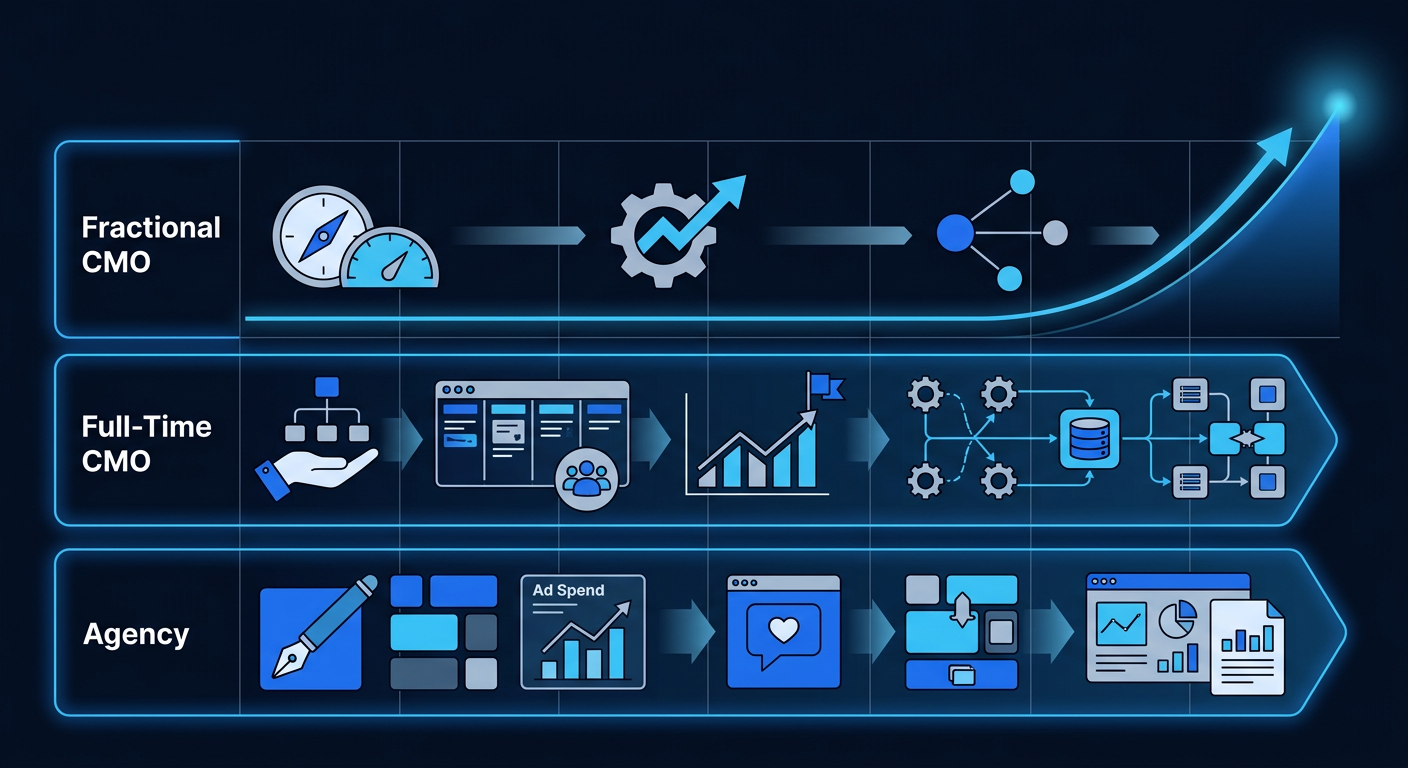
A fractional CMO is a senior marketing leader who joins part-time to own strategy and orchestrate execution across GTM, demand generation, product marketing, and revenue operations. They plug into leadership meetings, align with sales and product, and install processes that scale. Unlike agencies, they are accountable for outcomes across functions, not just channels.
Fractional differs from interim and full-time roles. Interim CMOs usually bridge a vacancy in a full-time role with similar hours and internal ownership. Fractional engagements are scoped for outcomes, with 1–3 days per week or similar capacity. Full-time hires require headcount, equity, and a months-long search; fractional starts fast and stays flexible.
Core responsibilities span ICP and segmentation, positioning and messaging, pricing and packaging, channel strategy, paid and lifecycle programs, partner motions, sales enablement, and RevOps foundations—funnel architecture, SLAs, attribution, and forecasting. For AI customer service automation, they also align with product on integrations, security messaging, and vertical case studies.
Typical engagement models include weekly retainers (e.g., 16–40 hours), project-based sprints (e.g., three-month GTM overhaul), or hybrid setups with a pilot month then a retainer. Expect time commitments of 8–20 hours weekly at seed, 16–32 hours at Series A/B, with heavier lifts during launches. Cadences include weekly ops meetings and biweekly board-ready updates.
B2B SaaS Demand Gen Channels That Scale
Why Hire a Fractional CMO for SaaS Startups

Speed to market matters. A fractional CMO can stand up a focused GTM and initial pipeline within 30–45 days using proven playbooks. Founders skip long interview loops, and marketing teams gain direction immediately. Early momentum compounds through faster testing cycles and clearer handoffs with sales.
Cost efficiency is a core driver. Instead of a full executive package, equity, and a large team, you pay for targeted capacity and outcomes. Savings can be channeled into media, data, and enablement. For SMB-focused AI automation, shaving weeks off onboarding and activation lifts near-term ARR faster than a slow full-time ramp.
Access to senior expertise on demand brings pattern recognition across categories and stages. A strong fractional CMO carries benchmarks, messaging frameworks, and channel priorities that have worked elsewhere. That means fewer dead ends and faster conviction on bets like partner programs or lifecycle triggers.
Flexible, results-focused engagements reduce risk. Month-to-month or quarterly terms let you pivot if priorities shift. A clear plan with OKRs and dashboards ensures visibility. For boards and investors, this demonstrates disciplined growth management and a path to full-time leadership once the model is proven.
Alignment with investor expectations improves credibility. Boards want a working growth model, not just spend. A fractional CMO can define the growth equation—traffic, conversion, sales velocity—and report cohort, payback, and pipeline health cleanly. This supports fundraising narratives and expansion decisions with evidence.
Fractional CFO for runway and budget alignment
When to Hire a Fractional CMO for SaaS Startups

Pre–product–market fit, engage when you have steady user feedback, early retention signals, and 3–5 referenceable customers. The fractional CMO tightens ICP, refines messaging, and sets a low-burn experimentation plan. Post–product–market fit, bring them in to scale channels, formalize pricing, and build RevOps to support sales velocity.
Signals include stalled growth after initial traction, rising CAC with low-quality pipeline, or plateauing activation and retention. A fractional leader isolates bottlenecks—weak onboarding, misaligned ICP, or channel saturation—and re-allocates spend. They also fix lifecycle gaps to reduce churn and unlock expansion revenue.
Plan ahead for capital events and expansion. Before seed or Series A/B, a fractional CMO builds the GTM narrative, evidence of repeatability, and a pipeline forecast founders trust. For international moves, they adapt messaging, pricing, and channels to local dynamics and prioritize compliant partners and data governance.
Marketing team gaps trigger need. If you lack leadership, product marketing, or demand gen muscle, a fractional CMO defines roles, hires contractors or agencies, and ensures accountability. They can also stabilize M&A integrations, unify brand architecture, and streamline overlapping tool stacks to reduce waste and confusion.
For brand repositioning—common in AI where the market shifts quickly—a fractional CMO leads research, coordinates customer advisory boards, and pilots new packaging. They then align sales enablement with the new story, ensuring demos, battle cards, and ROI calculators land with both buyers and customer success.

SaaS Pricing Strategy Playbook
Key Outcomes a Fractional CMO Should Deliver

Expect a crisp ICP and segmentation. Define firmographics, technographics, and triggers that correlate with activation and expansion. For AI customer service SMBs, prioritize ticket volume thresholds, CRM/Helpdesk integrations, and compliance needs. Validate value propositions through message testing and win/loss insights.
GTM strategy should include positioning, messaging, pricing, and packaging. The fractional CMO documents narrative arcs for economic, technical, and user buyers. They run pricing experiments—tier restructuring, usage add-ons, and success-based options—then align packaging to outcomes like deflection rate or CSAT improvements.
A durable demand engine matters. Blend content-led growth with paid search and social, programmatic retargeting, and partner-led motions. Launch ABM for high-fit accounts and community tactics for SMBs. Lifecycle campaigns should trigger on product events—first bot deployed, integration connected, or first resolution—driving activation and expansion.
Revenue operations is the backbone. Implement funnel architecture, handoff SLAs, lead scoring, and attribution. Standardize definitions—MQL, SQL, SAL—then build forecasting by stage conversion and sales velocity. Clean data flows across CRM, MAP, product analytics, and billing. Dashboards surface weekly insights, not just vanity metrics.
Product marketing outcomes include launch plans, sales enablement, and competitive strategy. Produce battle cards, ROI calculators, demo scripts, and objection handling focused on AI accuracy, latency, and privacy. Codify a release marketing cadence that pairs feature drops with proof points and customer storytelling.
Establish a metrics framework with a growth model, OKRs, and dashboard cadence. Tie initiatives to pipeline contribution, activation rate, expansion %, and net revenue retention. Use weekly WBRs to course-correct. For paid channels, watch CAC payback and marginal efficiency; for lifecycle, emphasize and PQL-to-SQL rates.
When to bring in a Fractional CTO
How to Hire a Fractional CMO for SaaS Startups
Define scope and success metrics before outreach. Decide on top outcomes—e.g., validated ICP, 30% lift in SQLs in 90 days, or a Series A GTM package. List constraints: existing tools, team capacity, and budget ranges. Specify vertical focus if relevant, such as SMB-heavy AI customer service with helpdesk integrations.
Source candidates through founder networks, at VC firms, vetted marketplaces, and referrals from CROs or product leaders. Shortlist 3–5 leaders who have shipped in your stage and motion. Prioritize those with references from CEOs who can speak to pipeline and NRR impact.
Evaluate fit beyond resumes. Ask for stage fit (pre/ post PMF), vertical expertise, and examples of pricing or packaging shifts. Review case studies with metrics and timeframes. Check references across CEOs and CROs. Probe for RevOps literacy, experimentation frameworks, and ability to coach or augment your current team.
Use trial projects and 30–60–90 plans. A 2–4 week sprint to deliver ICP, messaging tests, and a demand plan is ideal. The 30–60–90 should show hypotheses, experiments, and dashboard definitions tied to ARR targets. Ensure there is a weekly cadence, clear owners, and pre-committed time for enablement and ops.
Contract terms should include time allocation, KPIs, IP ownership, data security, and exit clauses. Protect your CRM and data pipelines. Agree on reporting formats and access to tools. Include a pilot month with renewal gates based on leading indicators—pipeline coverage, activation lift, and sales cycle improvements.
Fractional CMO Playbook for SaaS Growth
Start with a 30–60–90 day roadmap mapped to ARR goals. In 30 days, align ICP, install dashboards, and deploy quick wins—retargeting, intent enrichment, and onboarding triggers. In 60 days, launch ABM, refine pricing tests, and fix handoffs. In 90 days, scale channels that hit CAC payback targets.
Design your pipeline from MQL to SQL to Closed Won with realistic conversion benchmarks. Define qualification with sales input. Ensure SLA-driven handoffs and a sales assist function for PLG motions. Track velocity and remove friction—slow demos, missing ROI proofs, or unclear next steps.
Channel mix should include content-led growth anchored in problem/solution guides, paid search on high-intent terms, and paid social for mid-funnel education. Add programmatic or native for retargeting and partners for credibility and reach. Use ABM for larger SMB+ accounts, with tailored offers and consultative content.
Lifecycle marketing drives onboarding, activation, expansion, and churn prevention. Trigger emails and in-app nudges based on product usage. Pair customer education with milestone-based success content. Use playbooks for expansion—usage thresholds, new team invites, and advanced features—orchestrated with CS for timing and proof.
Run pricing and packaging experiments to improve LTV/CAC. Test usage-based levers like monthly interactions or agent seats, and tier benefits aligned to outcomes—automation rate, workflow complexity, or compliance. Validate uplift with win rates, discounting trends, and expansion behavior rather than raw MRR only.
Align sales and marketing around ICP, messaging, and enablement assets. Maintain living documents for personas, objection handling, competitive traps, and ROI calculators. Hold weekly SMARKETING reviews to examine funnel efficiency, stuck deals, and collateral needs. Keep a shared scorecard with leading and lagging indicators.
Budgeting and ROI: What It Costs to Hire a Fractional CMO

Pricing models vary: hourly for ad hoc advisory, retainer for ongoing leadership, project-based for GTM or pricing initiatives, and hybrid. Retainers offer predictability and alignment, while projects suit pre-funding proof points. Include clear deliverables, reporting cadences, and escalation paths in every model.
Market rates track seniority and scope. Expect higher rates for leaders who have built GTMs in your specific motion (PLG or sales-led) and vertical. Packages that include hands-on execution or in-depth RevOps work also price higher. Ask for example engagement mixes to understand time allocation across strategy and execution.
Model ROI using pipeline contribution, CAC payback, and ARR impact. Attribute lifts to specific programs and track marginal efficiency. Calculate CAC including leader time, media, creative, and tools. Monitor payback by cohort and channel. Tie roadmap items to expected pipeline boosts and validate with weekly dashboards.
Account for hidden costs: tooling, media spend, creative production, data enrichment, and team resourcing. Plan for RevOps and analytics support early, not as an afterthought. In AI-heavy categories, include budgets for compliance content, integration builds, and security reviews that influence enterprise or regulated SMB buyers.
Use sample budget scenarios to align expectations. At seed, prioritize foundational assets and tightly-scoped paid tests. At Series A, expand channels and enablement. At Series B, invest in ABM and partner ecosystems while hardening RevOps and attribution.
Sample fractional CMO budget scenarios (illustrative structure, not pricing claims)
Common Mistakes to Avoid When You Hire a Fractional CMO
Vague goals lead to misalignment. Define 2–3 revenue-linked outcomes and 3–5 input metrics with targets and timeframes. Require a plan with experiments, owners, and timelines. Review weekly and course-correct based on data, not opinions.
Under-resourcing execution stalls progress. A fractional CMO sets direction; they still need a pod—demand gen, content, design, ops—to ship. Budget for contractors or a specialist agency bench. Clarify who owns what and remove roadblocks quickly.
Ignoring data infrastructure and RevOps foundations cripples attribution and forecasting. Prioritize clean CRM hygiene, consistent funnel stages, and reliable tracking. Instrument key product events and connect them to MAP and CRM. Don’t scale spend until dashboards prove signal.
No owner for post-strategy implementation causes drift. Assign an internal program manager or revenue lead to operationalize the plan. Create a weekly checklist and a shared roadmap. Hold teams accountable to SLAs, experiment velocity, and documentation.
Short time horizons undermine results. While quick wins exist, structural improvements in activation, payback, and NRR need 1–3 quarters. Set interim milestones but commit to a realistic window. Insist on early leading indicators while acknowledging lagging metrics.
RFP Template and Interview Questions for Fractional CMOs
Structure your RFP to drive clarity. Include goals, KPIs, timelines, team composition, tech stack, budget range, and constraints. Share ICP hypotheses, traction signals, unit economics, and must-fix issues. Ask for a preliminary approach, work samples, and a draft 30–60–90 outline.
Interview questions should probe SaaS GTM craft. Ask how they evaluate PMF, choose channels, and balance PLG and sales-led. Request examples of pricing changes and their impact on win rates or expansion. Explore how they enable sales and collaborate with product on launches.
Assess experimentation and attribution rigor. Have them outline a testing framework—hypotheses, sample sizes, stopping rules, and success criteria. Ask how they handle mixed models—first/last touch, multi-touch, and media mix modeling—and how they prevent gaming of metrics.
Review case studies deeply. Request specifics: baseline metrics, actions taken, timeframes, and measurable outcomes. Ask what did not work, how they reacted, and which lessons are repeatable. Test for adaptability in AI-heavy categories with privacy, accuracy, or compliance hurdles.
Reference checks should include CEOs, CROs, and founders. Validate communication style, speed to impact, and partnership with sales. Probe for conflict navigation and transparency under pressure. Confirm their role in metrics improvements and the durability of results after they rolled off.
Applying the Playbook to AI Customer Service Automation for SMBs
AI customer service tools sell outcomes: faster resolution, higher deflection, and better CSAT at lower cost. The fractional CMO translates those outcomes into ICP criteria—ticket volume, channel mix, and integration priorities. They validate value props against real savings models and produce ROI calculators aligned to SMB finance.
Demand generation emphasizes high-intent search, partner integrations, and proof-laden content. Think “Zendesk automation” terms, marketplace listings, and case studies demonstrating deflection rates and. Retarget with snippets of real transcripts and before/after metrics to reinforce credibility.
Lifecycle is the growth engine. Triggered product tours, template libraries, and “recipe” catalogs get the first workflow live quickly. Celebrate milestones—first automated resolution, integration connected—via in-app prompts and emails. Use nudges for expanding channels (chat, email, voice) and adding team seats.
Pricing experiments can hinge on interactions processed, seats, or channels. Consider outcome-aligned tiers: starter for single-channel deflection, growth for omnichannel with analytics, pro for SSO, audits, and compliance. Test threshold-based nudges that surface upgrade ROI in the product, not just in marketing.
RevOps ties it together. Track PQLs from product signals—templates used, integration depth, and bot accuracy thresholds. Create a sales-assist motion for accounts with complex workflows. Attribute revenue to lifecycle triggers and partner referrals, not just ads, to guide investment.
Execution Pods: Minimum Team to Support a Fractional CMO
A small, capable pod accelerates impact:
- Demand gen generalist to run paid, retargeting, and reporting.
- Content strategist/writer for case studies, guides, and email/lifecycle.
- Designer with motion skills for ads and in-app education assets.
- RevOps/analytics to manage CRM/MAP, product events, and dashboards.
Supplement with contractors for SEO, video, and data enrichment. For SMB AI support, consider a solutions engineer or technical writer to create template packs, integrations documentation, and demo flows that reduce sales friction and speed activation.
Conversion Assets That Move the Needle
Create collateral mapped to buyer stages:
- Problem-aware: calculators for and deflection, benchmark studies.
- Solution-aware: integration one-pagers, security briefs, and comparison grids.
- Decision: demo scripts, ROI proof packs, and customer reference roster.
Build a self-serve toolkit for SMBs—templates, workflow libraries, and onboarding checklists. Gate strategic assets behind low-friction forms to feed PQL+MQL streams, and nurture with segmented sequences that echo product telemetry.
Governance, Compliance, and Risk Management
For AI-focused vendors, buyers scrutinize privacy, data retention, and model behavior. The fractional CMO partners with legal and engineering to publish transparent data sheets, SOC reports if relevant, and incident response overviews. Enable sales with concise security FAQs and review-ready documentation.
Establish brand and messaging guardrails for AI claims. Avoid overpromising accuracy or autonomy. Instead, emphasize workflows, feedback loops, and continuous improvement. Publish change logs for model updates and clarify opt-in/opt-out data usage to build trust.
Dashboards and Cadence: Operating Rhythm
Run a weekly business review with a standard scorecard:
- Pipeline coverage by segment and source; conversion and velocity by stage.
- CAC and payback by channel; marginal efficiency.
- Activation,, PQL rates, and expansion triggers.
- Churn, downgrades, and save reasons with linked actions.
Hold a monthly strategy review to rebalance portfolio bets. Archive decisions and hypotheses in a living doc. Maintain a shared roadmap visible to execs, sales, and product, with owner names and due dates. Use a quarterly retro to distill lessons and refresh the 30–60–90.
Partner Ecosystem: Multiplying Reach
Prioritize platforms and marketplaces your SMB buyers already use—helpdesks, CRMs, and e-commerce backends. Build co-marketing calendars, bundle offers, and integration stories that drive qualified traffic. Incentivize partners with MQL/SQL credits, joint webinars, and revenue-sharing where appropriate.
Recruit referral partners like CX consultants and boutique BPOs. Enable them with microsites, demo accounts, and sales scripts. Track partner-sourced pipeline separately, with clear attribution and SLAs for follow-up. Iterate based on partner feedback and shared customer outcomes.
Example 30–60–90 Plan Snapshot
- Days 1–30: Confirm ICP, audit funnel, set dashboards. Launch retargeting, fix lead capture, define MQL/SQL. Draft pricing test matrix. Ship two case studies and a problem-solution guide.
- Days 31–60: Stand up ABM light, intent enrichment, and partner listing optimizations. Launch onboarding triggers and PQL scoring. Run first pricing/packaging test. Enable sales with ROI calculator and battle cards.
- Days 61–90: Scale winning channels to CAC targets. Expand lifecycle plays for upsell. Publish competitive takeaways. Lock Q2 experiments and finalize hiring plan for demand gen and RevOps.
See current pricing on the provider’s official site — pricing and terms are updated there first.
Hire Fractional CMO for SaaS Startups
Use this quick comparison to decide the right leadership model for your stage, constraints, and goals. It highlights speed, cost structure, ownership scope, and risk profile so founders can match needs to engagement type without overcommitting headcount or delaying execution.
Conclusion
Hiring a fractional CMO for SaaS startups gives you senior GTM leadership, fast. With clear scope, a disciplined 30–60–90, and a capable pod, you can prove pipeline lift, improve activation, and hit payback targets without overhiring. Next step: define your 90-day outcomes and book a diagnostic to validate fit.
FAQ
How is a fractional CMO different from a marketing agency?
A fractional CMO owns cross-functional outcomes—strategy, demand, product marketing, and RevOps—embedded with your leadership team. Agencies typically execute specific channels or deliver assets. The fractional model aligns incentives to revenue metrics and installs operating rhythms, while agencies focus on deliverables within a narrower scope.
What should be in a 30–60–90 plan for a fractional CMO?
Include hypotheses, experiments, and success criteria tied to ARR targets. Outline ICP validation, messaging tests, channel pilots, lifecycle triggers, and RevOps fixes. Define dashboards, weekly cadences, and owners. Ensure milestones show early signal—SQL lift, activation rate—before scaling investment into channels that meet payback goals.
How do we measure ROI from a fractional CMO?
Track pipeline contribution by source, CAC and payback by channel, and improvements in activation, velocity, and expansion. Attribute impact to concrete initiatives—ABM, lifecycle, or pricing tests—and compare against baselines. Use weekly dashboards and monthly reviews to verify lift, shut down underperforming bets, and redeploy budget.
When is the right time to hire a fractional CMO?
Engage once you have signal on product value but need disciplined GTM execution. Triggers include stalled growth, high CAC, weak activation, pending fundraising, or expansion plans. If you lack leadership in demand gen or product marketing, or need RevOps foundations, a fractional leader can accelerate progress within weeks.
What budget should we plan beyond the leader’s retainer?
Plan for media spend, creative, data enrichment, analytics, and contractors for execution. Budget RevOps early for reliable attribution. Include lifecycle tooling and integration work, especially for AI products. Reserve funds for pricing tests and partner programs. Model CAC with all costs included and track payback at the cohort level.
Can a fractional CMO help with pricing and packaging?
Yes. They lead research, frame hypotheses, and run structured experiments across tiers, usage levers, and add-ons. Success metrics include win rate, discounting trends, expansion behavior, and payback, not just headline MRR. They align packaging to outcomes—like deflection or CSAT improvements—and equip sales with ROI calculators and messaging.