An AI chat layer on a B2B SaaS website does one narrow job well: it talks to a visitor who is already on a high-intent page, works out whether that visitor matches the profile your sales team wants to speak to, and then either books time with a person, hands the conversation to a person live, or records what it learned in the customer relationship management system so someone can follow up. Everything else marketed around that job is packaging.
This guide compares five products a B2B SaaS team can realistically buy for that job in 2026. It is written from vendor and platform documentation rather than from vendor sales decks, and it separates two kinds of statement throughout. A documented vendor fact is something the vendor or the CRM platform states in its own public documentation, cited inline. An Atlas editorial assessment is our reading of what that documentation means for a buyer, clearly labelled as judgement.
If you want the shortest possible version: the decision is rarely about which chat widget answers questions most fluently. It is about which product writes clean records into the CRM you already run, which one your team can configure without a specialist, and which vendor tells you enough about purchasing to let you plan a budget conversation.
How this comparison was built
The inclusion rule was deliberately mechanical, because a vague rule is how comparison articles end up listing whichever vendors run the loudest campaigns.
- Fit. The product must be sold for engaging and qualifying inbound website visitors in a business-to-business context, not purely for consumer support deflection.
- First-party documentation. The vendor must publish public product documentation describing how qualification is configured and how records reach a CRM. Products whose only public material is marketing copy were excluded.
- CRM reality. The product must document a supported path into Salesforce or HubSpot, since those are the two systems most B2B SaaS revenue teams actually run.
- Current product status. The product must be generally available and not announced as superseded. Where a well-known product is in transition, that transition is reported rather than hidden.
- Purchasing transparency, reported not required. A vendor is not excluded for keeping prices private, but the pricing table records exactly what is and is not published.
Evidence rules were equally mechanical. Capability statements cite vendor documentation, platform behaviour cites Salesforce or HubSpot documentation, and legal or accessibility points cite the relevant text rather than a summary of it. Paywalled analyst reports were not used as substitutes for vendor evidence, and vendor customer stories were treated as marketing rather than measurement.
Two things this guide deliberately does not contain. There is no hands-on bench test, because no Atlas author ran these five products side by side in a controlled environment, and pretending otherwise would be dishonest. There are also no outcome numbers — no meeting-rate figures, no pipeline figures, no sales-cycle figures — because the published versions of those numbers come from vendor case studies whose methodology is not disclosed, and an unverifiable number is worse than no number at all. What follows is a documentation review with labelled editorial judgement, which is a smaller claim and a more useful one.
What an AI chat qualification layer actually does
Strip the category down and there are five steps. A visitor arrives on a page. The chat agent engages, either because the visitor opened it or because a rule fired on that page. The agent asks a small number of questions and interprets the answers. Data about the company may be added from another source. Then a routing decision sends the visitor somewhere, and a record lands in the CRM.
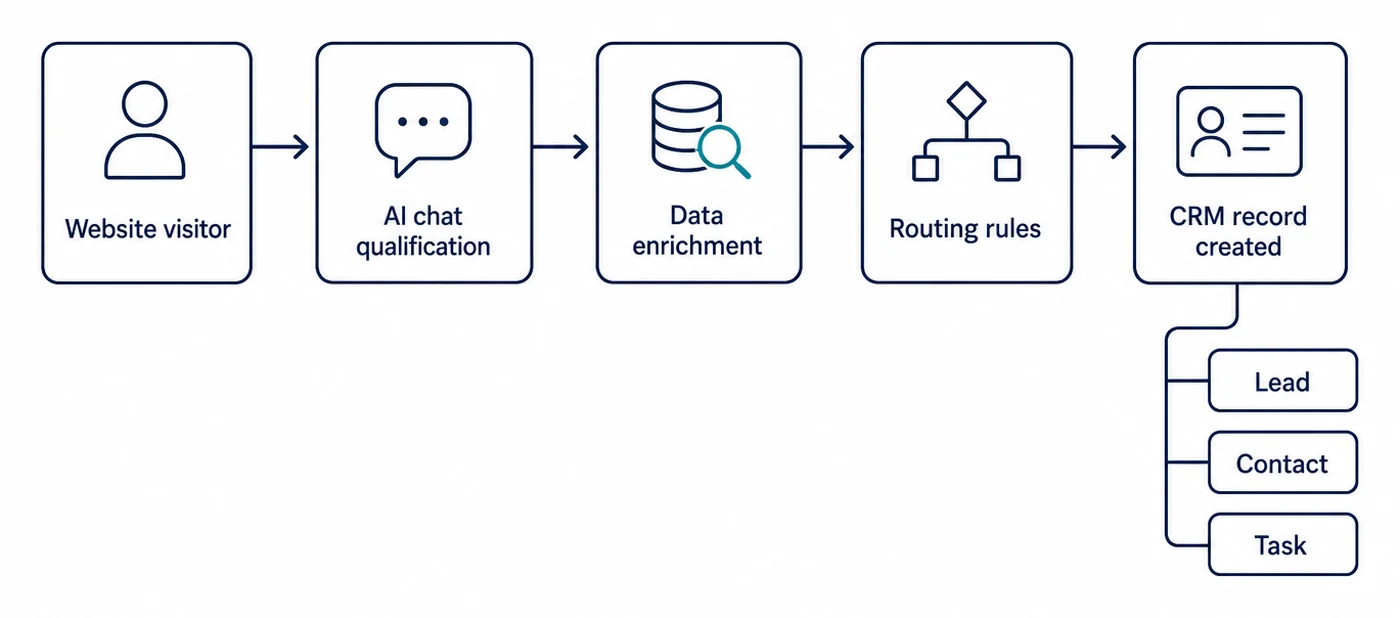
Each of those steps is a place where implementations fail, and none of the failures are about language quality. Engagement fails when the agent is deployed site-wide rather than on pages where intent is plausible. Interpretation fails when the qualification rules are written as marketing wishes rather than as objective attributes — Intercom’s own training documentation is unusually blunt about this, telling teams to define criteria as clear, objective characteristics such as company size, segment, industry, core use case, region and existing-versus-new customer status. Routing fails when the outcome the agent offers does not exist in the sales team’s calendar. The CRM step fails when the agent writes into fields nobody agreed on.
Atlas editorial assessment: the most common cause of an abandoned chat deployment we see described in public community threads is not the model. It is that nobody decided, before launch, which CRM object the conversation should create and who owns that object afterwards. That decision costs an afternoon and is easier to make before purchase than after.
The 2026 landscape, including one product in transition
Anyone researching this category will hit older articles that recommend Drift as the default answer for business-to-business conversational marketing. That recommendation is now out of date, and the change is documented by the companies involved rather than by rumour.
Documented vendor fact: in March 2026, Clari + Salesloft announced a partnership with 1mind, and 1mind publishes that announcement under the heading naming it the exclusive AI successor to Drift; the same partnership is announced on the Salesloft newsroom. Salesloft’s current website chat product is presented as AI chat agents feeding its revenue system, and its help centre maintains a Drift packages and availability article for existing customers. Salesloft’s public marketing pages describe outcomes for revenue teams; list prices are not published on those pages.
Atlas editorial assessment: a product with a publicly named successor is not automatically a bad product, and existing Drift customers are not stranded. But it changes the question a new buyer should ask. If you are signing a fresh multi-year agreement, ask which product line receives new capability, what the migration path to the successor product looks like, and what happens to your configured playbooks and historical conversation data if you move. Those are contract questions, not demo questions, and they belong in writing.
The rest of the field splits cleanly into two groups. Specialists — Qualified and Intercom — build the conversation layer as their product and connect outward to your CRM. Platform-native options — HubSpot’s customer agent and Salesforce Agentforce — build the conversation layer inside a system you may already pay for, which removes an integration and adds a dependency on that platform’s edition and packaging rules.
The five products, from their own documentation
Qualified — Piper, the AI SDR agent
Documented vendor fact: Qualified positions Piper as an autonomous inbound agent working across website conversations, email, meetings and Slack, and markets a Salesforce-oriented edition alongside its platform overview. Configuration is documented publicly in Qualified University: goals are created under Settings, Agent Studio and Goals, and each goal consists of trigger criteria, qualification criteria and goal actions such as booking a meeting or routing to a rep. Once a goal exists, the agent is told when to pursue it by mentioning the goal by name inside plain-language guides. Email follow-up is a separate documented surface, configured through plain-language instructions rather than template fields, with enrolment, exit criteria, sender identity and delivery schedule set per campaign. Qualified publishes a trust page and a broader documentation library, and its pricing page routes to a demo request rather than to published rates.
Atlas editorial assessment: the goal-plus-guide model is the most legible configuration pattern of the five, because the qualification logic lives in named objects an administrator can inspect and a marketing operations lead can audit. The documentation also shows the cost of that legibility: goals, guides, experiences and campaigns are separate surfaces, and someone has to own them. Qualified reads as the right shape for a team with a Salesforce-centred revenue operations function and enough inbound volume to justify a dedicated owner, and as overbuilt for a team of a few sellers who mainly need a booking path.
Intercom — Fin for Sales
Documented vendor fact: Intercom documents Fin for Sales as a role of its AI agent, trained through a playbook created under Fin AI Agent, Sales and Train. The documentation instructs teams to define qualification criteria, set the routing outcomes the agent may present, add guidance on tone and competitor handling, and supply a few example scenarios; routing outcomes are described as end states such as booking a call, starting a trial, escalating to support or politely disqualifying, with tagging and assignment handled later in workflow actions. A playbook can also be generated from the URL of your own pricing page. CRM writing is documented separately: Fin for Sales can create lead records in real time through data connectors, with pre-configured authentication flows for Salesforce, HubSpot and Attio, and inputs for each connector drawn from conversation history, previous actions or a direct question to the visitor. The underlying mechanism is Intercom’s data connector framework calling an outbound endpoint, and Intercom separately documents a HubSpot app, Salesforce integration troubleshooting guidance, its messenger and inbox model and a public contacts API. Intercom is the only vendor here that publishes complete list pricing on its pricing page, including per-seat plan rates, a per-outcome charge for the AI agent, a free trial and an option to run the agent on top of an existing help desk; it also publishes a security page covering its compliance posture.
Atlas editorial assessment: Fin for Sales is the least ceremonious option to stand up, and the pricing transparency is genuinely unusual in this category — you can model a budget before speaking to anyone. The trade-off is architectural: lead creation runs through a generic connector you configure, rather than through a managed CRM package, which means field mapping and error handling are your responsibility and belong in a runbook. Intercom’s heritage is customer service, and it shows in the way sales qualification is layered onto the service agent. For a product-led SaaS company that already uses Intercom for support, adding the sales role is the path of least resistance. For a sales-led company with a complex Salesforce schema, the connector approach deserves scrutiny from whoever owns that schema.
HubSpot — customer agent and chatflows
Documented vendor fact: HubSpot’s customer agent is documented as available with Professional and Enterprise tiers of its hubs, and its lead qualification article states that the agent can ask qualifying questions, evaluate prospects, score leads against criteria you define, and route qualified opportunities to sales. The same article records the operational fine print a buyer needs: configuring lead qualification does not consume HubSpot credits, but credits are required to deploy the agent to channels, the customer agent editor permission is required to configure it, and an assigned seat is required. Setup and behaviour are documented in the setup guide and the overview, multi-brand configuration in a separate article, and the agent can be deployed into workflows and rule-based chatbots. Deterministic alternatives remain documented for teams that want them: bot building, bot actions and live chat. Downstream, HubSpot documents lifecycle stages, the meetings tool, workflow automation, attribution reporting and a public contacts API, and publishes list pricing for its sales products.
Atlas editorial assessment: if your CRM is HubSpot, this is the option with the fewest moving parts, because qualification, routing, booking and reporting share one data model and one permission system. The catch is packaging rather than capability. Edition requirements, seat assignment and credit consumption for channel deployment are three separate levers, and a team on a lower tier can discover that the feature it read about is not the feature its subscription includes. Read the availability banner at the top of each HubSpot article before designing anything, and confirm credit behaviour with your account team in writing.
Salesforce — Agentforce with Messaging for Web
Documented vendor fact: Salesforce documents Agentforce as its platform for configurable AI agents, and Messaging for Web as the channel that places a conversation surface on your website, with a published setup guide. Because the agent runs on the platform, the object model is the platform’s own: leads, lead conversion, assignment rules and queues are all documented Salesforce behaviour, as are permission sets, field-level security, connected apps, campaign influence, setup audit trail and data export. Salesforce publishes an Agentforce pricing page, maintains a public trust and security site, and lists partner applications on the AppExchange.
Atlas editorial assessment: this is the option that treats the chat conversation as a first-class platform event rather than as an external system’s output, which is exactly what a security-conscious operations team wants — permissions, sharing and audit all behave the way the rest of your org behaves. It is also the option that demands the most administrator time, and the one where a small team without a Salesforce specialist will struggle to get a good result. Choose it when Salesforce is the system of record, the schema is already opinionated, and you have someone who genuinely enjoys configuring it. Our companion guide on AI meeting assistants for Salesforce covers the same permission and object questions from the post-meeting side.
Clari + Salesloft — AI chat agents
Documented vendor fact: Salesloft markets AI chat agents that engage website visitors and feed signals into seller workflows inside its revenue system, and its help centre documents Drift packages and availability for customers on that lineage. The March 2026 partnership announcement with 1mind, mirrored on 1mind’s own announcement page, names 1mind as the exclusive AI successor to Drift. Salesloft does not publish list prices for chat agents, and its detailed configuration documentation sits behind a customer login rather than on the open web.
Atlas editorial assessment: this option makes sense in one specific situation — you already run Salesloft for sequences and want website conversations landing in the same seller workflow rather than in a separate inbox. Outside that situation, the combination of a named successor product and configuration documentation that is not publicly inspectable makes it hard to evaluate before a sales conversation. We are not able to verify its current qualification configuration model from public sources, and we say so rather than describing it from marketing copy.
Two adjacent categories keep appearing in searches for this topic and are worth naming so you do not buy the wrong thing. Meeting routers and calendar concierge products solve the booking and round-robin problem but do not qualify a conversation. Data enrichment providers append company attributes but never speak to anyone; if that is the gap, our guide to B2B data enrichment tools is the better starting point.
Vendor decision matrix
Every cell below reflects what the vendor or platform documents publicly, in the wording of that documentation rather than in ours. Where public documentation does not answer a column, the cell says so; that absence is itself a purchasing fact.
| Product | Deployment model | How qualification is configured (documented) | Documented CRM write path | Booking and handoff (documented) | Public configuration documentation |
|---|---|---|---|---|---|
| Qualified (Piper) | Specialist agent alongside your CRM, marketed with a Salesforce-oriented edition | Named goals with trigger criteria, qualification criteria and goal actions, referenced from plain-language guides | Salesforce-oriented product line; CRM data used for agent context | Goal actions include booking a meeting or routing to a rep; separate meetings and email surfaces | Open web, in Qualified University |
| Intercom (Fin for Sales) | Specialist messenger and AI agent, connected outward to your CRM | Playbook trained with qualification criteria, routing outcomes, guidance and example scenarios | Real-time lead creation through data connectors, with pre-configured authentication for Salesforce, HubSpot and Attio | Routing outcomes include booking a call, self-serve trial, escalation to a person or polite disqualification | Open web, in the Intercom help centre |
| HubSpot (customer agent) | Native to HubSpot; requires Professional or Enterprise tiers per the availability notice | Agent actions that ask qualifying questions, evaluate prospects, score against your criteria and route | Native HubSpot records; no external integration required | Native meetings tool and live chat handoff; agent also deployable into workflows and rule-based bots | Open web, in the HubSpot knowledge base |
| Salesforce (Agentforce with Messaging for Web) | Native to Salesforce; website channel provided by Messaging for Web | Agent topics and actions configured on the platform, governed by standard platform administration | Native platform objects, including leads, conversion, assignment rules and queues | Handoff through documented messaging and service routing on the same platform | Open web, in Salesforce Help |
| Clari + Salesloft (AI chat agents) | Chat agents inside a revenue orchestration platform, with a publicly named successor product for the Drift lineage | Not publicly documented; configuration guidance sits behind a customer login | Not publicly documented in open web material; signals are described as feeding seller workflow | Marketed as routing buyer signals into seller actions; specifics not publicly documented | Login required for detail; packages article available in the help centre |
Purchasing and pricing availability
This table records the availability of purchasing information, not the amounts. Rates change, promotional terms change, and a figure copied into an article ages badly. What matters when you are planning a budget conversation is whether the vendor will tell you anything before a demo, and which unit it charges against.
| Product | Public list pricing | Documented unit of charge | Self-serve trial documented | Purchase path | Not publicly documented |
|---|---|---|---|---|---|
| Qualified (Piper) | Not publicly documented | Not publicly documented | Not documented; the pricing page routes to a demo request | Contact sales through the demo request form | Rates, contract length, agent volume limits |
| Intercom (Fin for Sales) | Published on the public pricing page | Per-seat plan rate plus a charge per resolved AI outcome, with channel charges billed separately | Free trial offered on the pricing page | Self-serve signup, or contact sales for larger plans | Negotiated enterprise terms and annual commitments |
| HubSpot (customer agent) | Published on the public sales pricing page | Seat-based subscription by hub and tier, with credits consumed when the agent is deployed to channels | HubSpot documents free tools and paid tier upgrades | Self-serve upgrade, or contact sales for larger portals | Credit consumption modelling for a specific conversation volume |
| Salesforce (Agentforce with Messaging for Web) | Published on the Agentforce pricing page | Platform licensing plus agent consumption, per the pricing page | Not documented as a self-serve trial for this configuration | Contact sales, or purchase through an existing account team | Total cost for a specific org, which depends on edition and add-ons |
| Clari + Salesloft (AI chat agents) | Not publicly documented | Not publicly documented | Not documented | Contact sales | Rates, packaging and the migration path to the named successor product |
Atlas editorial assessment: pricing transparency is not a proxy for product quality, but it is a proxy for how much of your evaluation time gets consumed by scheduling. If your team has to justify a number to a finance partner before it can trial anything, a vendor that publishes rates removes a whole week of calendar friction from the process.
Where the conversation lands: CRM object mapping
The single most consequential design decision in this project is which record a qualified conversation creates. Get it wrong and you generate duplicate work for the sales team, corrupt your reporting, or both. The two dominant CRMs model the same commercial reality differently, and the chat product inherits whichever model you already run.
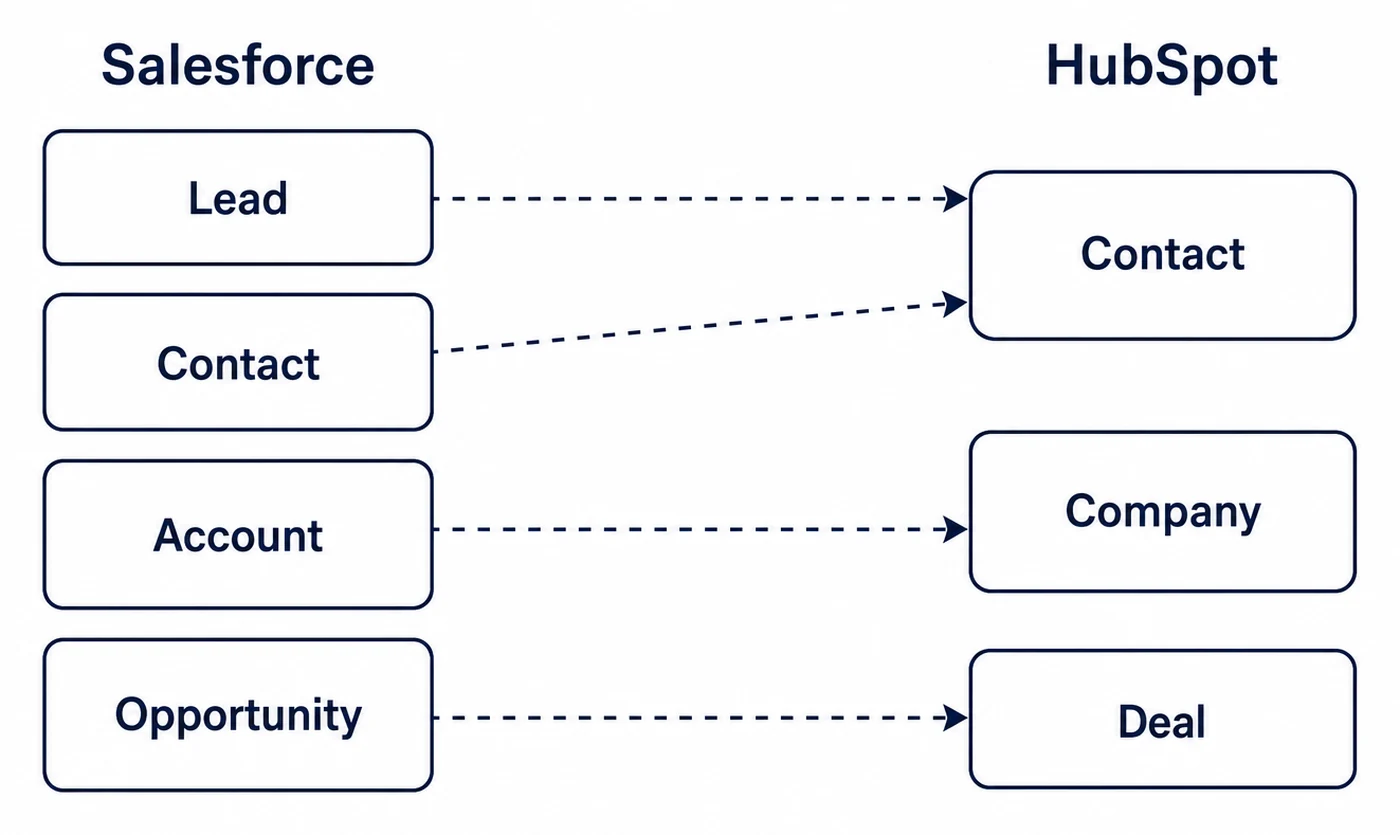
Salesforce keeps unqualified interest in a separate lead object that is later converted into a contact, an account and optionally an opportunity. HubSpot has no separate lead object in that sense; a person is a contact from first touch, associated with a company, progressing through lifecycle stages, with a deal created when there is something to forecast. Neither model is better. They demand different chat configuration.
On Salesforce, decide before launch whether the agent creates a lead or matches an existing contact, because a chat agent that blindly creates leads for known customers will pollute the funnel. Then decide which fields the conversation may write, and constrain that with field-level security on the integration identity rather than by trusting configuration. Assignment is a solved platform problem through assignment rules and queues, so let the platform do it instead of duplicating routing logic inside the chat tool.
On HubSpot, the equivalent decisions are which properties the agent may set, which lifecycle stage a qualified conversation triggers, and whether stage progression happens in the agent or in a workflow. Our recommendation on that last point is unambiguous: put stage transitions in workflows. A single place for stage logic is the difference between reporting you trust and reporting you argue about.
Atlas editorial assessment: write the field mapping down as a table your CRM administrator signs off before configuration starts, and give every field an owner. This is unglamorous work, and it is the entire difference between a chat deployment that survives its first quarter and one that gets quietly switched off. If you are formalising this kind of process work more broadly, our guide to implementing AI automation covers the same discipline applied to other systems.
Booking, live handoff and the honest limits of automation
A qualified conversation has three possible endings, and a well-designed deployment supports all three rather than forcing everything down one path. Hand the visitor to a person now, put a meeting on a calendar, or capture what you know and follow up asynchronously.
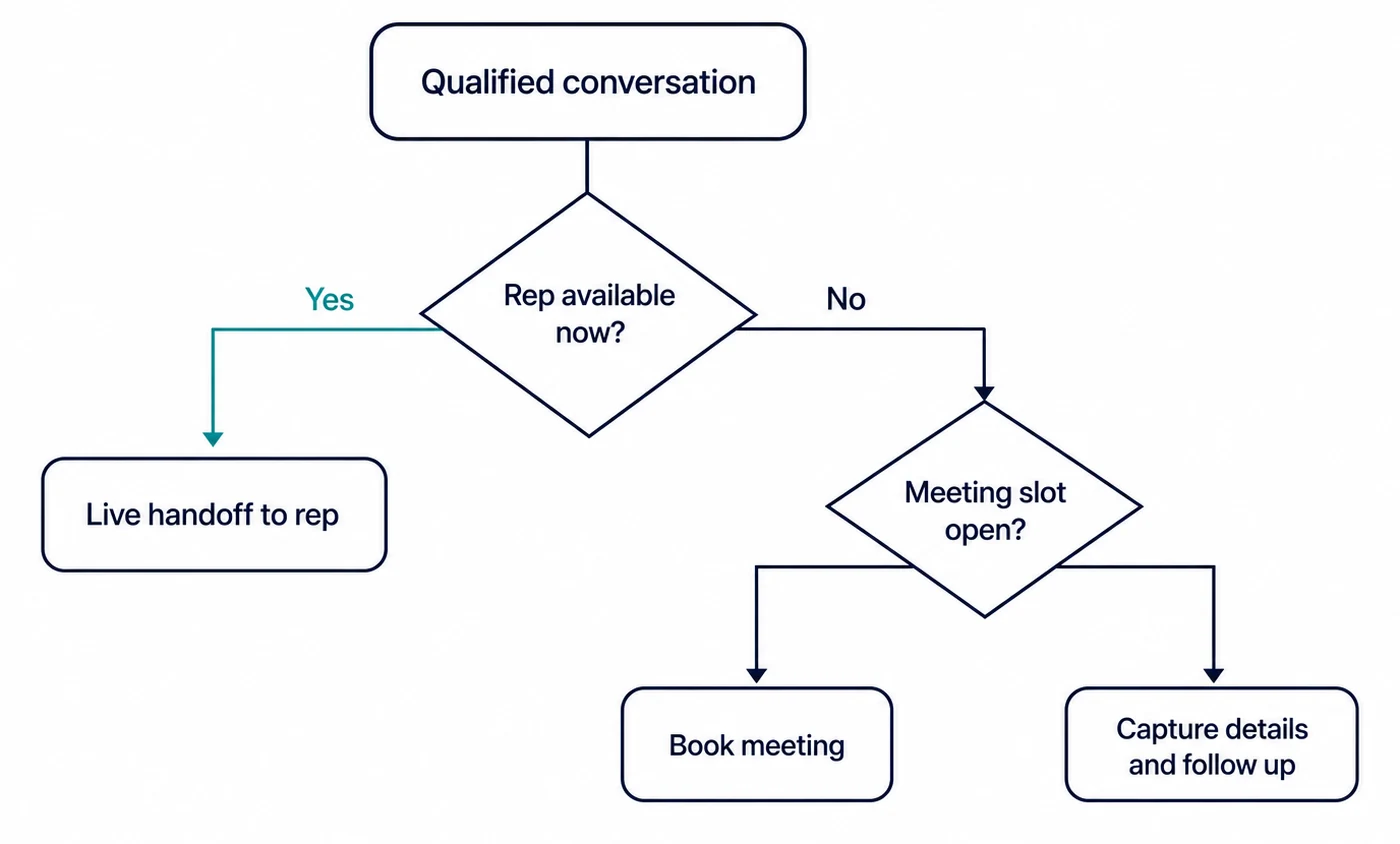
Live handoff is the highest-intent ending and the hardest to staff, because it depends on a person actually being present. HubSpot documents live chat alongside its agent, Intercom documents the agent handing off inside its inbox model, and Salesforce routes through documented messaging channels into standard service routing. The failure here is organisational, not technical: if a chat agent promises a person and no person appears, the deployment has produced a worse experience than a plain contact form.
Booking is the ending most teams actually want. HubSpot’s meetings tool is native to its CRM, Intercom documents booking as a routing outcome within the playbook, and Qualified documents booking as a goal action with a dedicated meetings capability. The unglamorous prerequisite is calendar hygiene. Ambiguous availability, unowned territories and stale round-robin membership break booking far more often than the agent does.
The third ending deserves more respect than it usually gets. A visitor who does not want to talk to anyone today still told you something useful, and capturing that cleanly — with the attributes the connector was configured to collect — is a legitimate success state. Configure agents so that graceful, honest disqualification is available too. Intercom’s documentation lists polite disqualification as a first-class routing outcome, which is the right instinct: an agent that qualifies everyone is not qualifying at all.
Atlas editorial assessment: decide your escalation rule before launch and write it into the agent’s guidance. Ours would be simple — when a visitor asks the same question twice, asks anything about contract terms, or expresses frustration, stop automating and get a person involved. For a broader discussion of where that line sits, see our comparison of AI chatbots and human support.
Attribution: showing what the chat layer contributed
Once the agent is live, someone will ask what it produced. Answering credibly requires an unbroken chain of records, and the chain breaks in predictable places.
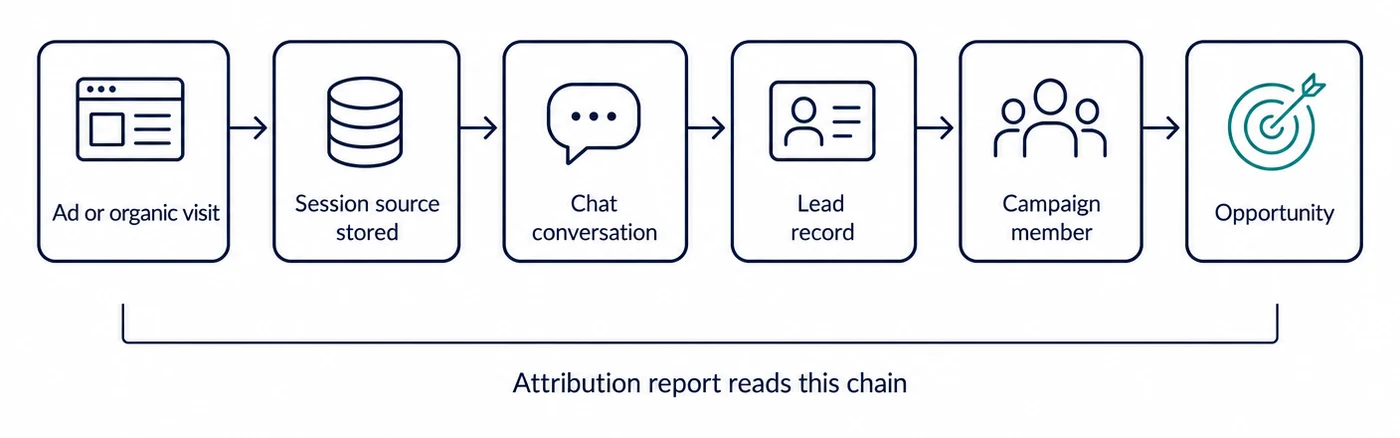
Both platforms document the machinery. HubSpot supports attribution reporting across interactions recorded against a contact, and Salesforce documents campaign influence for crediting multiple touches on an opportunity. Neither can report on a touch that was never recorded, which is where consent and tracking configuration become a reporting problem rather than only a compliance one: if your consent framework blocks the analytics identifiers Google’s consent documentation describes, the first link of the chain is missing and no downstream report can reconstruct it.
Atlas editorial assessment: report on states you can verify inside your own systems — conversations held, qualified conversations, meetings booked, meetings attended, records created and records that later progressed — and stop there. Resist the temptation to publish a modelled revenue figure internally, because the first time someone audits it and the numbers do not reconcile, you lose the credibility of the honest metrics as well. Attribute conservatively, document how you counted, and let the trend do the arguing.
Governance, permissions and retention
A chat agent is an authenticated system writing into your CRM on behalf of your company, and it holds transcripts of conversations with prospects. Both facts have governance consequences, and both are easier to handle before launch than during a security review.
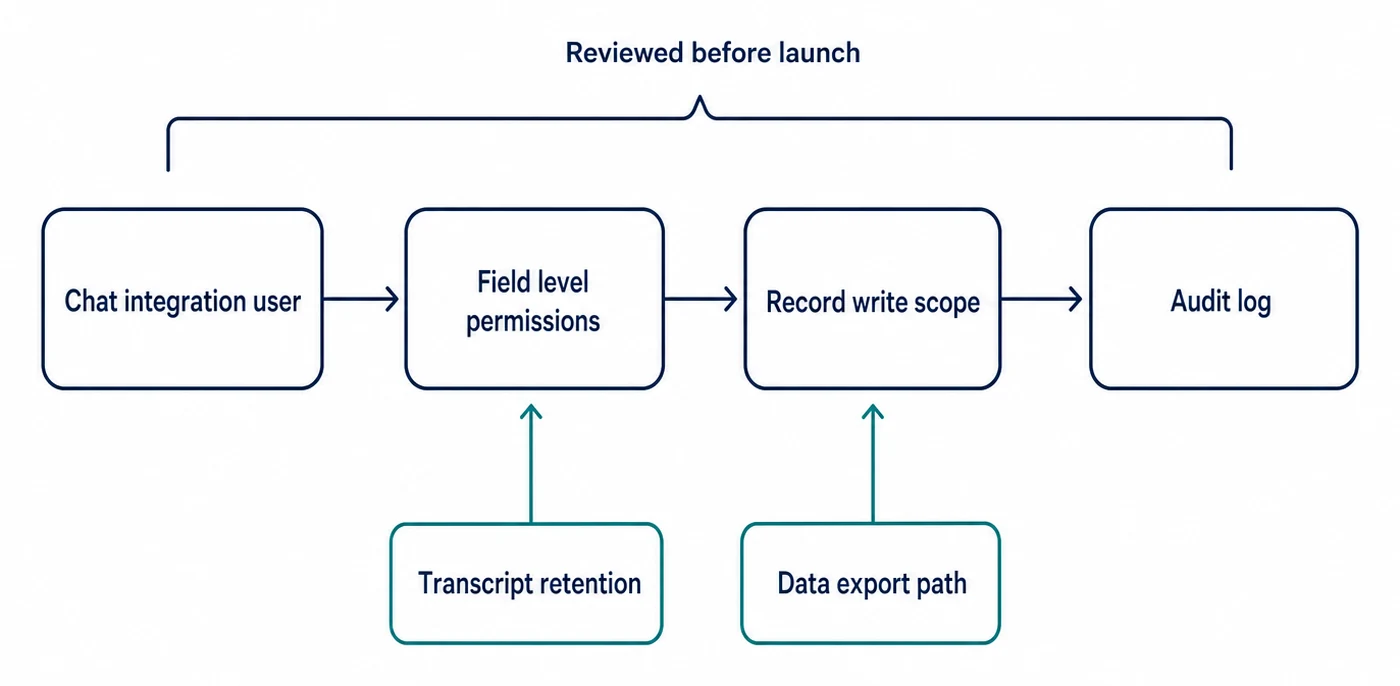
- Identity and scope. On Salesforce, the integration identity should be constrained with permission sets and field-level security, and any external connection reviewed as a connected app. HubSpot documents the editor permission and assigned seat its agent configuration requires.
- Change visibility. Salesforce records administrative changes in the setup audit trail, which is what you will want when someone asks who altered a routing rule.
- Exit and portability. Confirm how conversation data leaves the system. Salesforce documents data export; for a specialist vendor, ask directly about transcript export format and retention windows, and record the answer.
- Vendor assurance. Vendors publish security posture pages — Intercom’s security page, Qualified’s trust page and Salesforce’s trust site — and independent assurance is best understood through the SOC 2 framework rather than through a badge on a marketing page.
- Legal basis and automated decisions. If you handle personal data of people in Europe or the United Kingdom, the lawful basis for chat processing sits under Article 6, restrictions on solely automated decisions with significant effects sit under Article 22, and storage or access on a visitor’s device is governed by the electronic communications rules. Take advice on your own facts.
- Risk framing and accessibility. Governance vocabulary for the AI component is available in the NIST AI Risk Management Framework, and the chat widget itself is part of your website, so it is in scope for accessibility requirements — keyboard operability, focus handling and contrast are testable against the published criteria.
Atlas editorial assessment: the accessibility point is the one most teams miss entirely, and it is both the cheapest to fix early and the most awkward to explain later. Test the widget with a keyboard and a screen reader before launch, not after a complaint. Teams tightening broader access controls at the same time may find our single sign-on guide useful for the identity side of the same review.
A realistic sequence of work
Deliberately no calendar is attached to this sequence. How long each step takes depends on your CRM’s condition and on how quickly your sales leadership makes decisions, and any duration quoted in an article about someone else’s business is a guess dressed up as advice. The order, however, is stable.
- Define the qualified conversation. Write down the objective attributes that make a visitor worth a seller’s time, in the plain terms Intercom’s training documentation recommends. If sales and marketing cannot agree here, no tool will resolve it for you.
- Agree the record contract. Which object, which fields, which owner, which duplicate rule. Signed off by the CRM administrator before configuration begins.
- Pick the deployment surface. A small set of high-intent pages, not the whole site. Fewer surfaces mean cleaner learning and fewer irrelevant conversations.
- Configure qualification and outcomes. Goals and guides in Qualified, a playbook in Intercom, agent actions in HubSpot, topics and actions on the Salesforce platform.
- Wire routing to real calendars. Confirm ownership, coverage and round-robin membership are current before the agent starts promising meetings.
- Run a staffed pilot. Have a person read every transcript while volume is small. Nothing else surfaces bad qualification logic as fast.
- Instrument the chain. Verify each hop of the attribution chain end to end with test conversations before anyone reports on it.
- Review transcripts on a fixed cadence. Treat qualification rules as living configuration, and keep a change log so a reporting anomaly can be traced to a configuration change.
Atlas editorial assessment: the step teams skip is the staffed pilot, and it is the one that pays for itself. Reading transcripts is tedious and it is also the only reliable way to discover that your agent is confidently misdescribing your product to buyers. If your team is also automating the steps after the meeting is booked, our guide to automating client onboarding picks up the process from there.
Three buying situations
Product-led SaaS with a small sales team, already using Intercom for support
Adding the sales role to an agent you already run avoids a second widget, a second vendor relationship and a second set of transcripts to govern. The published pricing lets you model the change before asking anyone for approval, and the connector approach to lead creation is proportionate at this size. The thing to verify first is your CRM field mapping, because the connector will do exactly what you configure and nothing more.
Sales-led SaaS on Salesforce with a revenue operations owner
Here the realistic choice is between a Salesforce-oriented specialist and building on the platform itself. If inbound volume justifies a dedicated owner and you want goal logic that a marketing operations lead can inspect, the specialist route is defensible. If your security team wants everything inside the platform’s permission and audit model, Agentforce with Messaging for Web is the coherent answer. Either way, the object and field contract is the deciding constraint, not the conversational quality of the demo.
Marketing-led SaaS running HubSpot end to end
Staying native removes an integration, a duplicate identity and a reconciliation problem, and keeps qualification, booking and attribution in one data model. The homework is packaging: confirm your tier includes the customer agent, confirm seat assignment, and get credit consumption for channel deployment explained in writing before you plan volume. Teams comparing this with a lighter-touch automation approach may want our automation platform comparison alongside it.
Limitations of this guide
Stating what this article cannot tell you is part of making the rest of it trustworthy.
- No hands-on testing. This is a documentation review. No Atlas author ran these five products against a shared set of visitors, so nothing here should be read as a performance comparison.
- No outcome claims. We do not report meeting rates, conversion changes, pipeline effects or sales-cycle effects, because the public sources for those figures are vendor case studies without disclosed methodology.
- Documentation moves. Every citation was reachable in September 2026. Product packaging, edition requirements and agent capabilities in this category change frequently; verify against the vendor’s page before you sign anything.
- Uneven evidence. Vendors that document configuration on the open web are inherently easier to describe accurately than vendors that keep documentation behind a login. That asymmetry is visible in the matrix, and it is a fact about disclosure rather than a verdict on quality.
- No named winner. We do not rank these products, because the deciding variable is which CRM you run and who owns it — a variable that lives in your organisation, not in the products.
- Not legal advice. The privacy, automated-decision and accessibility references are pointers to primary sources, not advice on your circumstances.
Questions buyers ask
Do we need an AI agent, or would a rule-based bot do the job?
If your qualification logic is a short branching questionnaire, a deterministic bot is easier to govern and easier to debug, and HubSpot still documents bot building and bot actions for exactly that case. An AI agent earns its place when visitors ask open questions your questionnaire cannot anticipate and you want them answered before the qualification step, rather than after it.
Which CRM object should a qualified chat conversation create?
On Salesforce, usually a lead for a new person and an activity against the existing record for a known contact, with conversion handled by your normal process. On HubSpot, a contact associated with a company, with a lifecycle stage change and a deal only once there is something to forecast. Decide the duplicate rule at the same time.
How do we stop the agent inventing answers about our product?
Constrain scope and give it good material. Intercom documents training the sales agent from your own content and even generating a configuration from your pricing page; Qualified documents guides that tell the agent when to pursue a named goal. Then read transcripts during a staffed pilot, add explicit guidance for the questions it handles badly, and route commercial-terms questions to a person.
Does an AI chat agent replace a sales development representative?
Vendor marketing in this category increasingly implies that it does. What the documentation actually describes is qualification, routing, booking and follow-up messaging under configuration you own. Judgement calls, relationship building and anything requiring commercial discretion are not covered by that description. Treat the agent as coverage for hours and volume your team cannot reach, and staff the escalation path properly.
What single thing most often derails these projects?
An unowned CRM contract. When nobody has agreed which record is created, which fields may be written and who follows up, the agent produces records the sales team does not trust and the deployment loses its sponsor. Settle that before configuring anything.
Should we run one agent for both support and sales conversations?
It is documented as possible — Intercom presents sales as a role of the same agent, and HubSpot documents deploying its customer agent across channels, workflows and rule-based bots. Whether it is wise depends on whether one set of guidance can serve two audiences without becoming vague. Many teams get better results from separate guidance on separate surfaces, even when the underlying agent is shared.
Sources
All documentation below was reachable in September 2026.
- Qualified University — create goals for Piper; setting up agentic email campaigns; documentation library.
- Qualified — platform overview; Piper for Salesforce; pricing; trust.
- Intercom Help — how to train Fin for Sales; Fin for Sales integrations, create leads in your CRM; how to set up data connectors; HubSpot app; Salesforce integration troubleshooting; what Intercom is.
- Intercom — pricing; security; create contact API reference.
- HubSpot Knowledge Base — set up the customer agent; set up customer agent actions to qualify leads; understand the customer agent; deploy the customer agent to workflows and rule-based chatbots; customer agents for brands.
- HubSpot Knowledge Base — create a bot; guide to bot actions; create a live chat; use lifecycle stages; use meetings; create workflows; create attribution reports.
- HubSpot — sales pricing; contacts API reference.
- Salesforce Help — Agentforce; Messaging for Web; Messaging for Web setup guide; leads; convert leads; lead assignment rules; queues.
- Salesforce Help — permission sets; field-level security; connected apps; campaign influence; setup audit trail; data export.
- Salesforce — Agentforce pricing; trust and security; AppExchange.
- Clari + Salesloft — AI chat agents; Drift packages and availability; partnership announcement. 1mind — announcement naming it the successor to Drift.
- Law, standards and frameworks — GDPR Article 6; GDPR Article 22; ICO guide to electronic communications rules; Google consent documentation; WCAG 2.2; WCAG quick reference; NIST AI Risk Management Framework; AICPA guidance on SOC 2.